
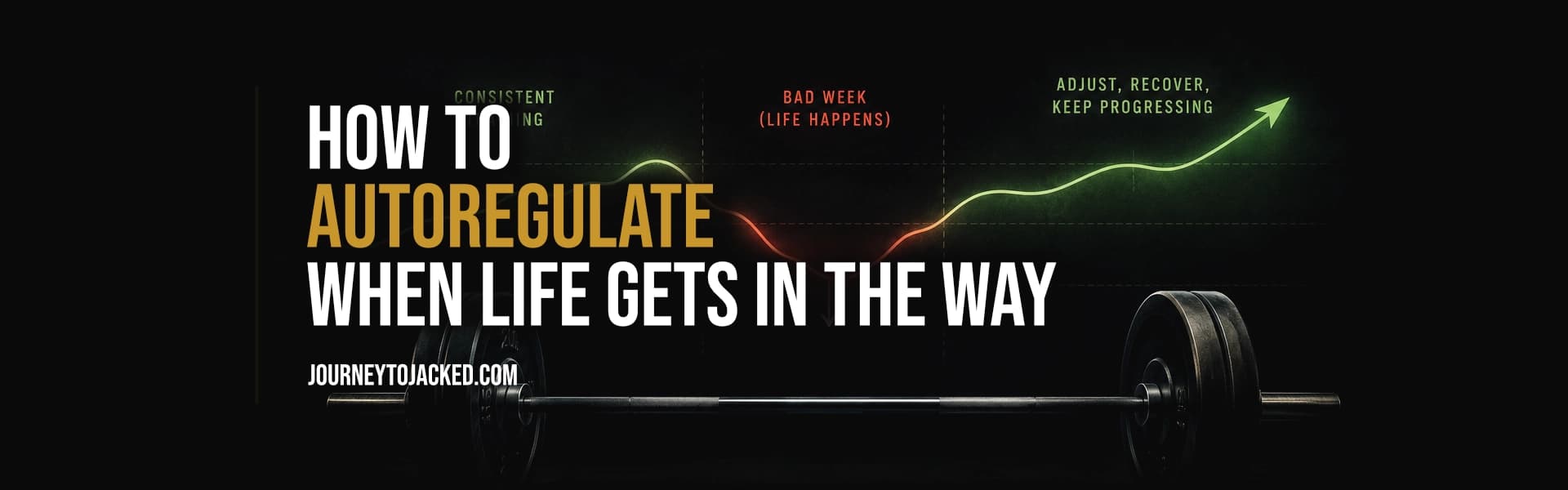
How to Autoregulate When Life Gets in the Way
Learn how to autoregulate training by adjusting load and volume around bad weeks so you keep progress instead of quitting.
A bad week hits. Work explodes, sleep tanks, and the program you committed to suddenly feels impossible.
Most people do one of two things here. They force the prescribed session and grind themselves into the ground, or they skip the week entirely and lose momentum.
There's a third option. You adjust the work to match the week. That's autoregulation, and it's how disciplined lifters stay on track for years instead of burning out in months.
What does it mean to autoregulate your training?
Autoregulation means adjusting your training load and volume based on how your body actually performs that day, instead of blindly following what's written on the page. You scale the work to your current capacity. On strong weeks you push. On bad weeks you pull back, but you still show up.
The program is the plan. Autoregulation is how you keep the plan alive when life refuses to cooperate.
Rigid programs assume every week looks the same. They don't. A fixed plan breaks the moment reality changes, and a broken plan gets abandoned. Autoregulation bends so it never breaks.
Why "just push through" usually backfires
Training is a stressor. Your body adapts to it during recovery, not during the session itself. When life already has you under-slept and overstressed, more hard training doesn't add progress. It adds to a hole you're already in.
Hard training under poor recovery raises your fatigue without raising your adaptation. You get the soreness and the drain with little of the muscle. This is why more training is rarely the fix for stalled gains. The issue is usually recovery, not effort. We break that down in why more training won't fix slow gains.
Heavy lifting in a deeply fatigued state also drives your nervous system down and raises injury risk. Grinding a max-effort squat on three hours of sleep is how good lifters get hurt.
So pushing harder on a bad week often costs you the next two weeks. That's a bad trade.
The autoregulation framework: 3 levers to adjust
When a bad week hits, you have three levers. Pull them in order. Touch the smallest one first and only go further if you need to.
Lever 1: Cut volume, keep intensity
Volume is your total work, sets times reps. It's the most fatiguing variable and the first thing to trim.
Drop your working sets by roughly a third to half. Keep the weight on the bar similar. You still hit a heavy enough load to hold your strength and muscle, but the total fatigue drops sharply.
Cutting volume while holding load is one of the most effective ways to maintain muscle through a hard stretch without digging a deeper hole 1.
- Normal week: 4 sets of squats
- Bad week: 2 sets at the same weight
Lever 2: Cut intensity, keep volume
Some weeks the problem isn't time, it's that you feel beaten down and heavy weight feels dangerous.
Here you keep your set count but drop the load. Pull the weight back 10 to 20 percent and leave 3 to 4 reps in the tank on every set. You keep the movement pattern, the practice, and the blood flow without the grind.
This is the better lever when your joints ache, your sleep is wrecked, or your stress is sky-high and bar speed feels off.
Lever 3: Cut the session, keep the lift
Some weeks you get 20 minutes. That's it.
Don't write the day off. Pick the one main lift that matters most and do a few quality sets. One compound movement done well beats a perfect session you never started.
A short, focused session keeps your training identity intact. You're still someone who trains, even on the worst weeks. That identity is what carries you through, far more than motivation ever will.
How do you know which lever to pull?
Match the lever to the limiting factor. If time is short, cut volume or shorten the session. If you feel physically wrecked or under-recovered, cut intensity. If everything is collapsing at once, cut the session down to one lift and call it a win.
Run a quick check before each session on a bad week:
- How much time do I actually have? Short on time, cut volume or shorten the session.
- How recovered do I feel? Beaten down, cut intensity.
- How is my sleep and stress? Both bad, pull two levers, not one.
The goal is never zero. The goal is the most useful work the week allows.
When to deload instead of autoregulate
Sometimes one bad week is actually several stacked on top of each other. If your performance has been sliding for two to three weeks straight, you're not having a bad week. You're accumulated and you need a planned deload.
A deload is a full, intentional week of reduced load and volume to let fatigue clear. It's not failure. It's built into every smart program. If autoregulation is the daily dial, the deload is the scheduled reset.
If you want the full picture of how deloads fit into a long-term plan, read periodization explained for people who just want to lift.
With autoregulation, the discipline is in the adjustment, not the grind
Skipping the week is easy. Grinding yourself into the ground is also easy. Neither takes much thought.
The hard, disciplined move is the adjustment. Show up, read the week honestly, pull the right lever, and do the work that actually fits. That's not lowering your standard. That's protecting your progress so you're still standing in six months.
Bad weeks aren't the threat. Quitting during them is. Autoregulation is how you make sure a bad week stays a bad week, not the end of your run.
What to do next
Next time life gets in the way, don't cancel and don't grind. Pull one lever, do the work that fits, and keep your streak alive.
A program built with autoregulation already baked in makes this automatic. It tells you exactly how to scale on the weeks that fall apart, so you never have to guess.
Your Next Step
Stop guessing. Start building.
Get a personalised training plan built around your body, your goals, and your schedule — ready in minutes, yours forever.
Get Your PlanReferences
Footnotes
-
Bickel, C. S., Cross, J. M., & Bamman, M. M. (2011). Exercise dosing to retain resistance training adaptations in young and older adults. Medicine & Science in Sports & Exercise, 43(7), 1177–1187. https://doi.org/10.1249/MSS.0b013e318207c15d ↩