
How to Cut Fat Without Losing Muscle
Most cuts strip muscle along with fat. Here is the deficit framework that keeps your gains while you lean out, built for naturals.
Most cuts strip muscle right along with the fat. You step on the scale, the number drops, and you call it a win. Then the mirror tells the truth. Smaller, softer, flatter. You did not get lean. You got smaller.
That is the trap. Losing weight is easy. Losing fat while keeping the muscle you built is the actual skill. Naturals do not have the hormonal safety net that lets you cut sloppy and stay full. Get the deficit wrong and your body eats the muscle you spent years earning.
This is the framework that keeps your gains while you lean out. Built for naturals who lift.
How big should your calorie deficit be to keep muscle?
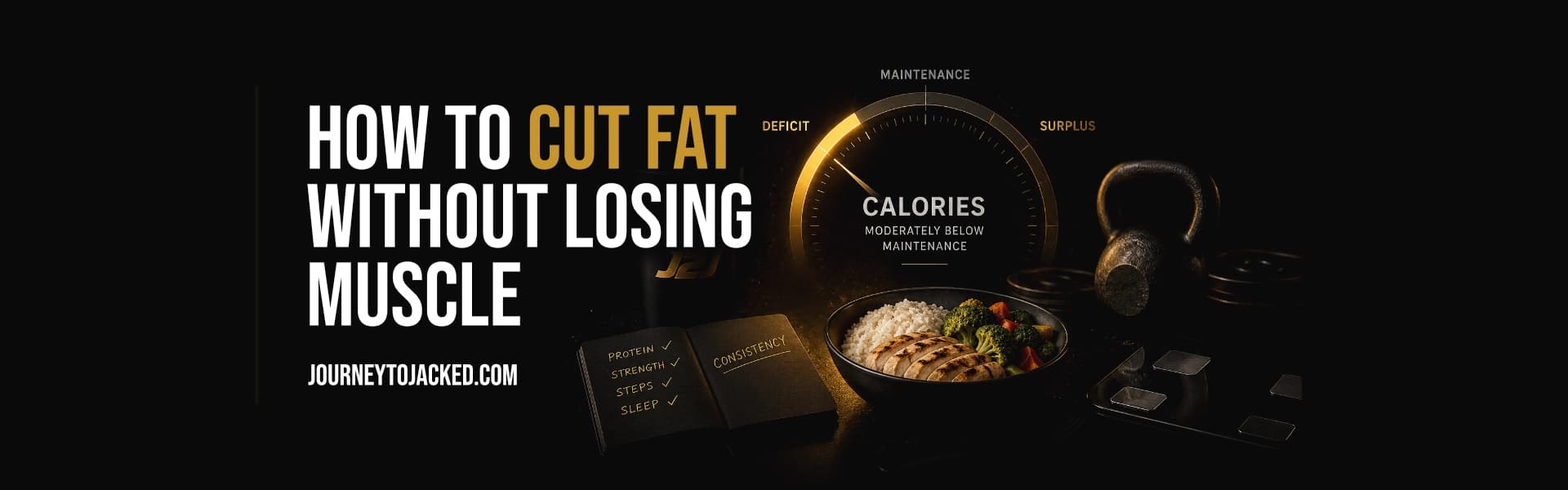
For most lifters, a moderate deficit of 300 to 500 calories below maintenance is the sweet spot. That is roughly 10 to 20 percent under your maintenance calories. It is steep enough to drop fat each week and shallow enough to protect muscle.
The size of the deficit is the single biggest lever. Push it too hard and your body breaks down muscle for fuel because muscle is expensive to maintain.
Scale the deficit to how lean you already are:
- Higher body fat (men over 20%, women over 28%): You can run the deeper end, 500 calories or so. You have more fat to pull from, so muscle is at lower risk.
- Lean already (men under 12%, women under 20%): Tighten to 250 to 300 calories. The leaner you get, the harder your body fights to keep fat and burn muscle instead.
Bigger is not better. Deficits past 750 to 1000 calories speed up the scale but raise the risk of muscle loss, especially for experienced lifters with less fat to give.
How fast can you cut without losing muscle?
Aim to lose 0.5 to 1 percent of your body weight per week. For a 180-pound lifter, that is about 1 to 1.8 pounds. Faster than that and you are likely shedding muscle and water, not just fat.
This is the rate rule, and it matters more than any single meal. Research on energy deficits shows that lean mass loss climbs as the daily deficit grows 1. Slow loss protects muscle. Fast loss sacrifices it.
The leaner you are, the slower you go. Someone with a lot of fat to lose can sit near the top of that range without much risk. A lifter already chasing abs should hug the bottom, closer to 0.5 percent per week, even though it feels painfully slow.
Patience is the strategy. Muscle you keep does not need to be rebuilt. Muscle you lose costs you months.
How much protein do you need to keep muscle while cutting?
Eat about 1 gram of protein per pound of body weight per day while cutting. For most naturals that lands between 0.7 and 1 gram per pound, and the higher end wins when calories are low.
Protein is non-negotiable in a deficit. It gives your body the signal and the raw material to hold muscle while fat comes off. A meta-analysis on protein and resistance training found that muscle and strength benefits keep climbing up to about 1.6 grams per kilogram of body weight, which is close to 0.7 grams per pound, then plateau 2. In a deficit, aiming higher buys you a margin of safety.
Two rules make it work:
- Spread it out. Hit 30 to 40 grams across four or five meals instead of cramming it into one.
- Anchor every meal with it. Build each plate around a protein source first, then fill the rest.
Not sure what your numbers are? Run them through the macro calculator and set your protein target before you touch anything else.
How do you know if you're losing muscle instead of fat while cutting?
Watch your strength, not just the scale. If your lifts hold steady or climb while your weight drops, you are losing fat. If your strength is sliding week after week, you are burning muscle.
The scale cannot tell muscle from fat from water. Your training log can. Track your main lifts and treat a steady drop in performance as a red flag, not a bad day.
Three signals that the cut is eating muscle:
- Your lifts stall or go backward for two or more sessions in a row under the same conditions.
- You look smaller but not leaner. Flat and soft instead of tight and defined means you shrank the wrong tissue.
- You feel wiped out and flat, with recovery dragging and pumps disappearing.
If you spot these, do not panic. Slow the rate of loss, push protein to the top of the range, and make sure you are still training hard. Confirm before you overhaul. A flat week on a low-carb day is glycogen and water, not lost muscle.
Can naturals build muscle while cutting?
Sometimes, but do not count on it. Beginners, people returning after a layoff, and those carrying a lot of fat can lose fat and build muscle at once. This is body recomposition, and it works best when you are new to lifting.
Trained naturals are different. The longer you have lifted, the harder it gets to build muscle in a deficit. For most experienced lifters, the realistic goal of a cut is to keep every ounce of muscle you have, not add to it.
That is not a downgrade. Holding 100 percent of your muscle while stripping fat is a win that reveals the physique you already built. Aim to maintain. Treat any new muscle as a bonus, not the plan.
Why are you losing strength on your cut?
Usually one of five things is off: the deficit is too steep, protein is too low, you stopped training hard, you piled on cardio, or you are under-recovered. Fix the inputs and strength comes back.
A cut done right is not just eating less. It is a system where every piece protects muscle. Drop one and the whole thing leaks gains. Here is the framework:
- Set a moderate deficit. 300 to 500 calories under maintenance, scaled to how lean you are.
- Cap the rate. 0.5 to 1 percent of body weight per week. No faster.
- Hit protein. Around 1 gram per pound, spread across the day.
- Keep lifting heavy. Hold your training intensity and volume. Heavy compound work tells your body to keep the muscle.
- Control cardio. Use it as a tool to widen the deficit, not a hammer. Too much cardio with too little food burns muscle.
- Recover hard. Sleep and rest are where muscle is protected. Shortchange them and the cut turns catabolic.
Miss one input and the cut starts taking muscle. Hit all six and you lean out while your strength holds. That is deficit done right.
Build the body. Own the journey.
A clean cut is a system, not a starvation contest. Set the deficit, cap the rate, hammer protein, keep the iron heavy, and recover like it matters. Do that and the fat comes off while your gains stay locked in.
Stop guessing at your numbers and start cutting with a plan built around your stats, your goals, and your schedule.
Your Next Step
Stop guessing. Start building.
Get a personalised training plan built around your body, your goals, and your schedule — ready in minutes, yours forever.
Get Your PlanReferences
Footnotes
-
Murphy, C., & Koehler, K. (2022). Energy deficiency impairs resistance training gains in lean mass but not strength: A meta-analysis and meta-regression. Scandinavian Journal of Medicine & Science in Sports, 32(1), 125–137. https://doi.org/10.1111/sms.14075 ↩
-
Morton, R. W., et al. (2018). A systematic review, meta-analysis and meta-regression of the effect of protein supplementation on resistance training-induced gains in muscle mass and strength in healthy adults. British Journal of Sports Medicine, 52(6), 376–384. https://doi.org/10.1136/bjsports-2017-097608 ↩