
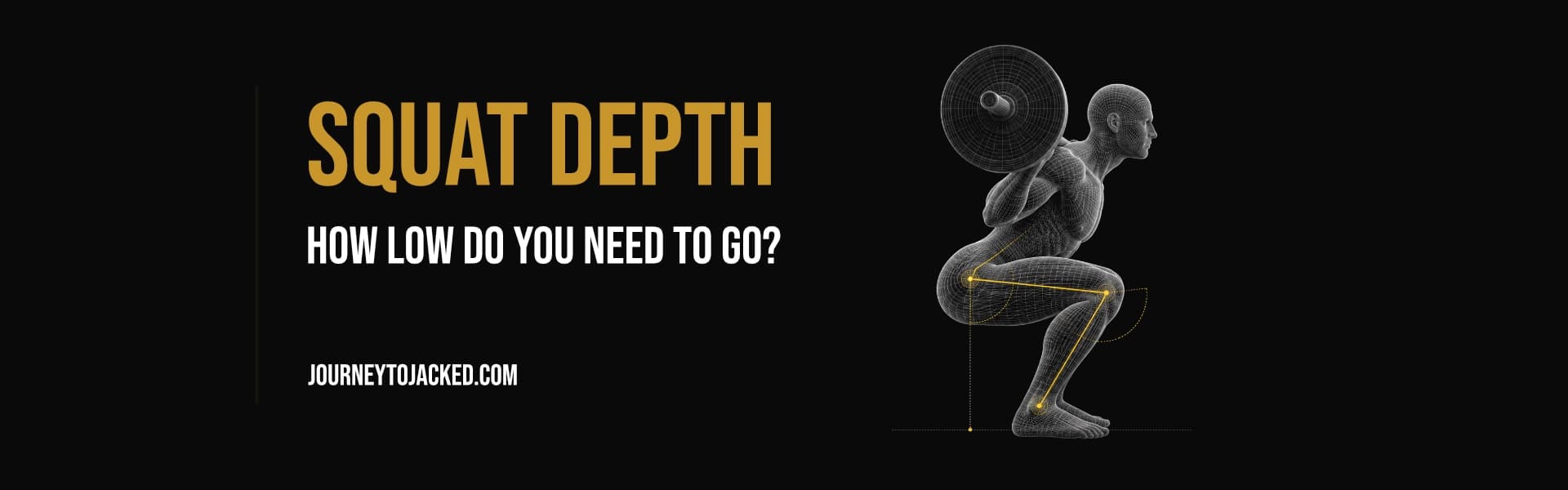
Squat Depth: How Low Do You Actually Need to Go?
How low do you really need to squat? Here is what the research says about squat depth, settling the parallel vs ass-to-grass debate for good.
Someone in every gym will tell you half-squats are pointless. Someone else will tell you deep squats wreck your knees.
Both are wrong. And the argument has gone on far too long.
Here is what the research actually says about squat depth, and how low you need to go to build legs.
How low do you need to squat?
For muscle growth, squat to at least parallel, where your hip crease drops to the top of your knee. Going below parallel adds more glute and adductor development, but parallel is the minimum threshold for full quad and glute stimulus. Depth below that is a bonus, not a requirement.
That is the direct answer. The nuance below is what stops you from either short-changing your legs or chasing depth your body cannot safely reach.
What counts as parallel depth on a squat?
Most people who say they squat to parallel are stopping high.
Parallel means your hip crease drops to or just below the top of your kneecap. It is not when your thighs look roughly flat. The visual estimate almost always overshoots how deep you actually are.
The fix is simple. Film your squat from the side. You will likely find you are stopping an inch or two short of where you thought.
Does Squatting Deeper Build More Muscle?
Squatting below parallel builds more muscle than stopping high, especially in the glutes and adductors. Deeper squats place the muscles under load through a longer range of motion, and full range training produces greater hypertrophy than partial range in most cases 1.
So the deep-squat crowd is partly right. More depth means more stretch under load, and stretch under load drives growth.
But there is a ceiling on that benefit, and a cost if you force depth your body is not built for.
The Range of Motion Trade-Off
Full range of motion wins for muscle growth. That is settled.
What is not settled is forcing a depth your hips and ankles cannot reach without breaking position. If your lower back rounds at the bottom, called butt wink, you have passed your usable range. Loading that position repeatedly is where risk creeps in, not the depth itself.
The goal is the deepest squat you can hit while keeping a neutral spine and your heels planted. For some that is well below parallel. For others, parallel is the honest limit today.
Will Deep Squats Hurt Your Knees?
No. Deep squats do not damage healthy knees. Research shows full-depth squatting does not increase injury risk in people with healthy joints, and the deep position is not inherently dangerous 2. The half-squat myth has been overturned by the evidence.
In fact, stopping at a quarter squat to load heavier weight often puts more shear stress on the knee than a controlled deep squat with lighter load.
If your knees hurt when you squat deep, the problem is usually technique, mobility, or load, not depth itself.
Why most people cannot squat deep yet
Depth is often a mobility problem disguised as a strength problem.
The usual limiters:
- Ankle mobility. Limited dorsiflexion stops your knees traveling forward, which forces you to cut depth. Elevating your heels slightly often fixes this overnight.
- Hip mobility. Tight hips cause the pelvis to tuck under at the bottom, the butt wink that rounds your lower back.
- Bracing. Losing core tension at the bottom collapses your position before your legs ever fail.
Forcing load onto a body that cannot reach depth cleanly is how the deep-squat fear got started. Fix the mobility, and the depth follows.
How Deep Should You Squat?
Squat to the deepest position you can hold with a neutral spine, heels down, and control. For most trained lifters that means parallel or just below. Chasing extreme depth at the cost of position trades muscle stimulus for injury risk. Depth serves the lift. The lift does not serve depth.
Master the same principle on your hinge work too. The Romanian deadlift form guide covers how range of motion and a neutral spine work together on the posterior chain. And if you want depth to translate into actual growth, progressive overload is how you keep loading that range over time.
What to Do Next
Film your next squat session from the side. Find your true depth.
If you are stopping high, work the mobility that is holding you back and own parallel first. If you already hit parallel clean, add depth gradually while keeping a neutral spine.
Squat as low as you can control. Not as low as the internet tells you to.
References
Footnotes
-
Schoenfeld, B. J., & Grgic, J. (2020). Effects of range of motion on muscle development during resistance training interventions: A systematic review. SAGE Open Medicine, 8, 2050312120901559. https://doi.org/10.1177/2050312120901559 ↩
-
Hartmann, H., Wirth, K., & Klusemann, M. (2013). Analysis of the load on the knee joint and vertebral column with changes in squatting depth and weight load. Sports Medicine, 43(10), 993-1008. https://doi.org/10.1007/s40279-013-0073-6 ↩
Your Next Step
Stop guessing. Start building.
Get a personalised training plan built around your body, your goals, and your schedule — ready in minutes, yours forever.
Get Your Plan