
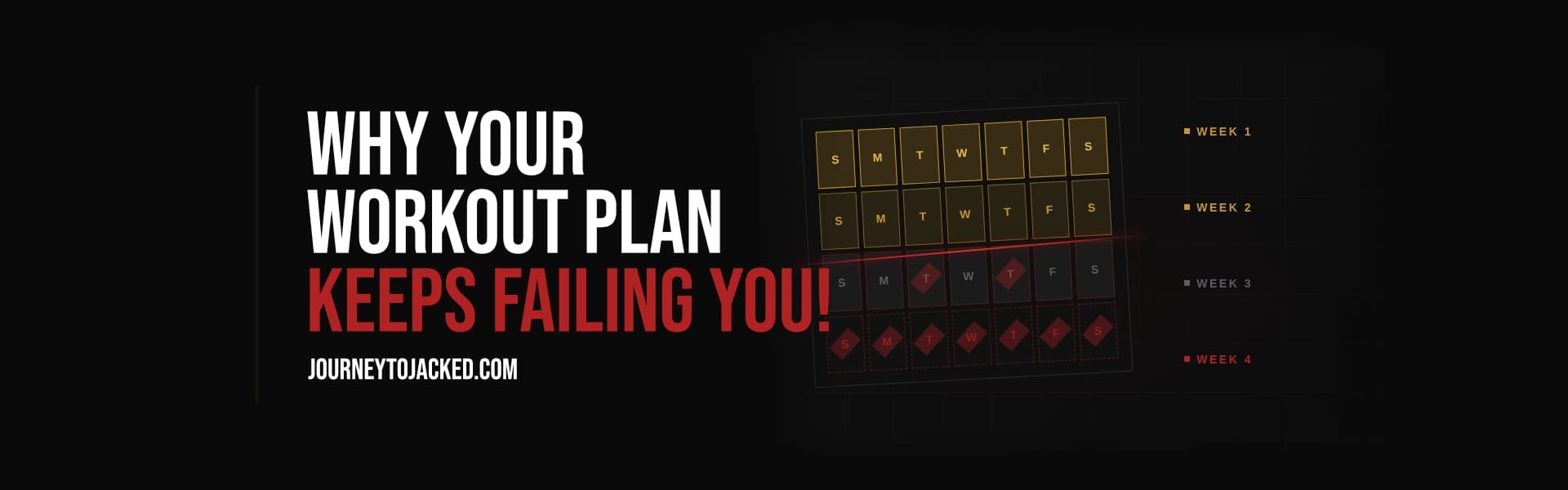
Why Your Workout Plan Keeps Failing You
Your plan isn’t the problem — the fit is, and a program that doesn’t match your life will always break before your discipline does.
Your plan isn't the problem. The fit is.
You started strong. First week, you showed up, did the work, felt the burn. By week three, life took over. You missed a session. Then two. Then the guilt made restarting feel harder than quitting.
You blamed yourself. Not enough discipline. Not enough motivation. But the truth is simpler and harder to hear: the plan wasn't built for you. A plan that doesn't fit your life will always fail, no matter how much willpower you throw at it.
Why Workout Plans Fail at Week Three
The drop-off almost never happens in week one. Motivation is still fresh, the routine is still new, and friction hasn't built up yet.
Week three is where generic plans break. Here's why:
- The schedule clashes with your real life. The plan says Monday-Wednesday-Friday. Your life says Tuesday-Thursday-Saturday. If you're lucky.
- Exercises don't match your equipment. Cable flyes sound great until you're training in a garage with a barbell and a bench.
- Volume outpaces your recovery. You're exhausted by Thursday because the plan was built for someone who sleeps eight hours and has zero stress. That person doesn't exist.
- There's no adjustment mechanism. A static plan can't respond to a bad night of sleep, a brutal work week, or an injury flare-up. You didn't fail the plan. The plan failed you.
The real problem with generic workout programs
Most workout programs are designed for a fictional average person. Same exercises. Same schedule. Same progression model. Same volume.
That average person doesn't have your job, your equipment, your recovery capacity, or your training history. A template doesn't know that you can only train three days a week, or that you've been stuck at the same bench press for six weeks.
Generic plans work briefly. They give you structure, which is better than nothing. But structure without personalization is a countdown to stalling out.
This is also why program-hopping becomes a cycle. The plan stalls, so you find a new one. The new one feels exciting for two weeks, then the same friction returns. You blame the program again and search for the next one. The pattern repeats. Not because you're picking bad programs, but because no template can account for the variables that make your situation unique.
The moment the plan stops fitting, you stop following it. Not because you lack discipline. Because the design assumed a life you don't live.
What a Plan Built for You Actually Looks Like
A plan that sticks has four things generic programs don't:
Your schedule is the foundation. Three days a week? Four? Five? Six? You set the number of days you can commit to your customized program.
Your equipment shapes the exercises. Home gym with dumbbells and a bench? Full commercial gym? Resistance bands in a hotel room? The movements match what you have access to.
Your recovery sets the volume. How much training you can handle depends on your sleep, your stress, your nutrition, and your training age. A beginner recovering from four sets of squats needs a different plan than an intermediate handling twelve sets a week across two sessions. A plan built for you accounts for all of it. Not just your goals.
Your goal drives the structure. Adding muscle, losing fat, building strength, improving endurance. Each goal demands a different rep range, rest period, exercise selection, and progression model.
When the plan fits, consistency stops being a fight. It becomes a habit.
The shift from generic to personalized training
Here's what separates people who transform from people who restart every January: they stop thinking of training as something they do and start seeing it as someone they are.
There's a difference between following a 12-week program and becoming a person who trains. The first is a project with an end date. The second is an identity. It compounds.
When your plan fits your life, when it's built around who you are and not who some template assumes you are, training stops feeling like a sacrifice. It becomes part of how you operate.
You don't debate whether to train on a Tuesday. You just train on Tuesday. The decision was already made. Not in the moment, but in who you decided to become.
That's when results become inevitable.
How to tell if your workout plan is the problem
Answer these honestly:
- Does your training schedule conflict with your life more than twice a month?
- Are there exercises you consistently skip or swap out?
- Do you feel more drained than recovered by the end of the week?
- Have your lifts stalled for more than three weeks?
- Is your plan actually aligned with your specific goal? Two or more yes answers means the plan doesn't fit. That's not failure. That's information. And it's the starting point for something better.
So What Now?
Chasing the "perfect" program is a dead end. It doesn't exist. Never did.
What works is something built around your reality. Your time, your setup, your energy, your goals, your recovery. The version of you that trains consistently isn't waiting for motivation to strike like lightning. That version is waiting for something that fits well enough to keep going, even on messy weeks.
That's exactly what Journey to Jacked builds. A training plan designed for your life. Not someone else's.
Stop looking for the perfect generic program and build something you can actually live with. The rest follows.
Build the body. Own the journey.
Your Next Step
Stop guessing. Start building.
Get a personalised training plan built around your body, your goals, and your schedule — ready in minutes, yours forever.
Get Your Plan