
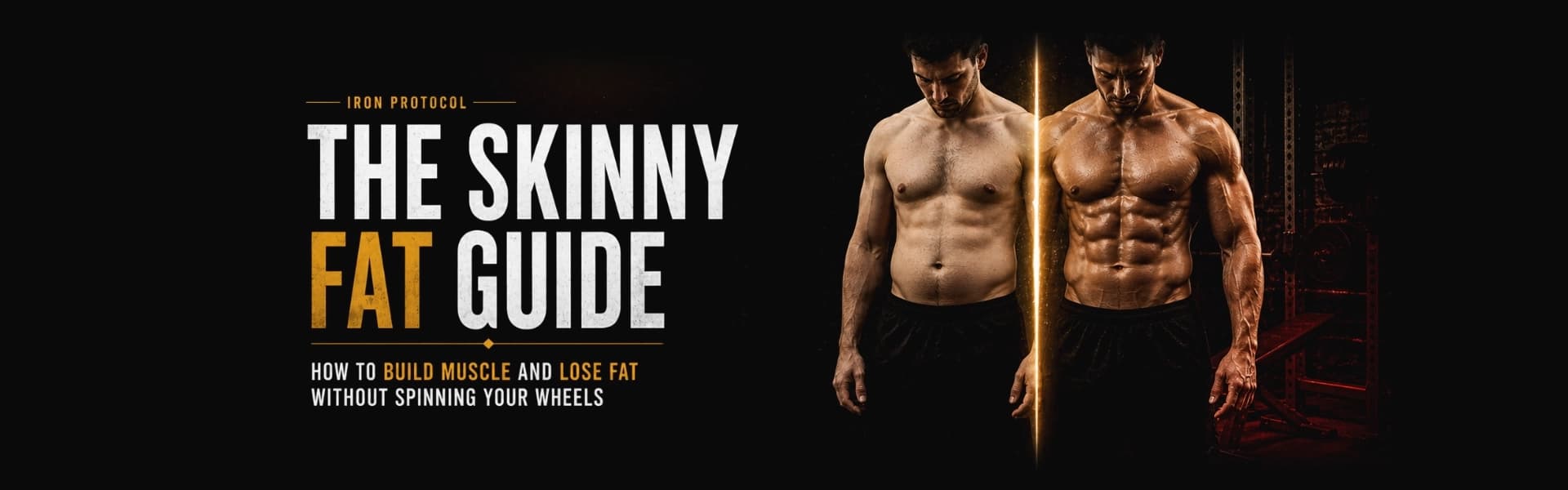
Skinny Fat Fix: How to Build Muscle and Lose Fat at the Same Time
You lift, you diet, you still look soft. Here's the step-by-step skinny fat fix to build muscle and lose fat without bulk-cut confusion.
You lift. You eat "clean." You've been at it for months. And you still look the same with your shirt off.
Soft midsection. Flat chest. Arms that disappear in a T-shirt. The scale says you're a normal weight. The mirror says otherwise. You're skinny fat, and it's one of the most frustrating places to be in fitness because nobody can give you a straight answer on what to do next.
Bulk or cut? More cardio or less? Eat more or eat less?
You've heard all of it. None of it has worked. That ends here.
This is the no-fluff, step-by-step guide to fixing a skinny fat physique. No spinning your wheels. No guessing. Just a clear plan built on what actually works.
What "Skinny Fat" Actually Means (And Why It Happens)
Skinny fat is a casual term for a real condition. The clinical name is Normal Weight Obesity or Metabolically Obese Normal Weight. It means your BMI looks fine on paper, but your body composition tells a different story. Too much fat. Not enough muscle.
Here's how it happens:
- Years of no resistance training. Cardio and dieting without lifting strips muscle over time. What's left is a soft, undefined physique even at a low body weight.
- Chronic under-eating followed by overeating. Crash diets tank your metabolism. When you eat normally again, the calories get stored as fat, not used to build muscle.
- The wrong type of exercise. Hours on the treadmill burn calories. They don't build the dense, lean tissue that changes how your body looks.
- Poor protein intake. Without enough protein, your body has no raw material to repair and grow muscle, even if you're training. The result? You look "normal" in clothes. But underneath, your body is carrying more fat than it should and far less muscle than it could.
This isn't just about looks. Research shows that individuals with normal weight obesity carry elevated risk for insulin resistance, cardiovascular issues, and metabolic disease. Your body composition matters more than the number on the scale.
Why "Should I Bulk or Cut?" Is the Wrong Question
This is the question that keeps skinny fat people stuck for years.
If you bulk, you're terrified of getting fatter. If you cut, you're scared of looking even smaller. So you do neither. Or worse, you flip between the two every few weeks and make zero progress in either direction.
Here's the truth: you don't need to bulk or cut. You need to recomp.
Body recomposition means building muscle and losing fat at the same time. For most people, this sounds too good to be true. But for skinny fat beginners, it's not only possible. It's the single best approach.
Why? Because you have two things working in your favor:
- You're under-muscled. Your body responds aggressively to resistance training when you're new to it. This is called the "newbie gains" window, and it's real. Studies show untrained individuals can gain significant muscle even in a calorie deficit during this phase.
- Your fat cells are full. When fat cells are inflated with stored energy, your body is more willing to release that energy. It can literally fuel muscle growth with stored body fat. A meta-analysis of 116 resistance training studies found that participants gained nearly 2 pounds of muscle while losing over 2 pounds of fat in just 15 weeks. And those people weren't even following optimized programs.
You can do better. Much better.
The 4 Pillars of a Skinny Fat Recomp
Stop doing random workouts. Stop following generic meal plans. Fix these four things and your body will change.
1. Lift Heavy With Progressive Overload
This is non-negotiable. If you are not resistance training, nothing else in this article matters.
Your training should follow these principles:
- Compound lifts first. Squats, deadlifts, bench press, overhead press, rows, pull-ups. These movements recruit the most muscle and drive the most growth.
- Train each muscle group at least twice per week. Full-body or upper/lower splits work best for beginners. Push/Pull/Legs works once you're more experienced. Upper/lower vs PPL vs full body matches each one to your training days.
- Progressive overload every session. Add weight, add reps, or add a set. If you're doing the same thing you did last week, you're not growing.
- Train in the 6 to 12 rep range for most sets. This is the hypertrophy sweet spot. Go heavier (3 to 5 reps) on your main compound lifts. Go lighter (12 to 15 reps) on isolation work.
- Track your lifts. If you're not writing down your numbers, you're guessing. Guessing doesn't build muscle. Aim for 3 to 4 sessions per week. More than that isn't necessary at this stage and can actually hurt recovery.
2. Eat at Maintenance Calories (Not a Deficit, Not a Surplus)
This is where most skinny fat people go wrong. They either starve themselves or eat everything in sight. You need neither.
Eat at maintenance. That's it.
Your body will use stored fat to fuel muscle growth when you provide adequate protein and training stimulus. You don't need a calorie surplus to build muscle as a beginner, and you don't need a deficit to lose fat when your body composition is poor.
How to find your maintenance:
- Use a TDEE calculator to get your starting number.
- Eat that amount consistently for 2 weeks.
- If your weight stays roughly the same (plus or minus 1 to 2 pounds), you've found it.
- Adjust by 100 to 200 calories if needed. Don't overcomplicate this. Consistency matters more than precision.
3. Prioritize Protein Like Your Physique Depends on It (It Does)
Protein is the single most important macronutrient for body recomposition. It builds muscle. It preserves muscle during fat loss. It keeps you full. It has a higher thermic effect than carbs or fat, meaning your body burns more calories digesting it.
Aim for 0.8 to 1 gram of protein per pound of body weight every day.
If you weigh 170 pounds, that's 136 to 170 grams of protein daily. Non-negotiable.
Good protein sources:
- Chicken breast, turkey, lean beef
- Fish and shrimp
- Eggs and egg whites
- Greek yogurt, cottage cheese
- Whey protein powder (convenient, not required)
- Tofu, tempeh, lentils (plant-based options) Spread your protein across 3 to 4 meals per day. Each meal should have at least 30 to 40 grams.
Fill the rest of your calories with carbs and fats. Don't fear either one. Carbs fuel your training. Fats support hormones. Both matter.
4. Sleep and Recovery Are Not Optional
You don't build muscle in the gym. You build muscle when you recover. If you're sleeping 5 hours a night and walking around stressed out of your mind, your body composition will suffer no matter how perfect your training and diet are.
- Sleep 7 to 9 hours per night. This is when growth hormone peaks and muscle repair happens.
- Manage stress. Chronic stress elevates cortisol, which promotes fat storage (especially around the midsection) and impairs recovery.
- Don't train every single day. Rest days exist for a reason. Your muscles need 48 to 72 hours to recover and grow after being trained hard.
How to track skinny fat recomp progress when the scale lies
Here's something that trips up every skinny fat person: your weight might not change for weeks, even when your body is transforming.
That's because you're gaining muscle and losing fat at roughly the same rate. The scale doesn't know the difference between a pound of muscle and a pound of fat. But the mirror does. Your clothes do. Your strength numbers do.
Track these instead:
- Progress photos every 2 weeks. Same lighting, same angle, same time of day. Side-by-side comparisons don't lie.
- Waist measurement. If your waist is shrinking, you're losing fat. Period.
- Strength in the gym. If your lifts are going up, you're building muscle. Period.
- How your clothes fit. Shirts tighter in the shoulders and looser in the waist? That's recomp working. If your waist is going down and your lifts are going up, you're winning. Ignore the scale.
The 3 Mistakes That Keep Skinny Fat People Stuck
You now have the blueprint. But knowing what to do and actually doing it are different things. Here's what derails most people:
Mistake 1: Program Hopping Every 2 Weeks
Pick a program. Run it for at least 8 to 12 weeks. Stop chasing the "perfect" routine. The best program is the one you follow consistently and progressively overload on. Switching every time you see a new influencer post a workout is the fastest way to go nowhere.
Mistake 2: Doing Too Much Cardio
Cardio has its place. A 20 to 30 minute walk daily is great for health, recovery, and calorie burn. But if you're doing 45 minutes on the stairmaster after every lifting session, you're eating into your recovery and potentially burning muscle.
Keep cardio moderate. Prioritize resistance training. Walking is king for skinny fat recomp.
Mistake 3: Not Eating Enough Protein
This one kills more progress than anything else. You can't build muscle out of nothing. If your protein is under 100 grams a day and you weigh 170 pounds, you're leaving results on the table. Every single day.
Fix your protein first. Everything else becomes easier once that's locked in.
Your Skinny Fat Recomp Timeline (What to Expect)
Results aren't instant. But they're faster than you think if you stay consistent.
Weeks 1 to 4: You'll feel stronger. Lifts will go up quickly. Your body won't look much different yet. This is your nervous system adapting to resistance training. Trust the process.
Weeks 4 to 8: Visible changes start. Shirts fit differently. Your shoulders and arms start filling out. Waist measurement drops. This is where most people quit because the scale hasn't moved. Don't be most people.
Weeks 8 to 16: This is where the transformation gets real. Noticeable muscle definition. Clear reduction in body fat. People start asking what you've been doing. Your physique reflects the work you've been putting in.
Months 4 to 6+: You no longer look skinny fat. At this point, you can decide whether to lean bulk (add muscle with minimal fat gain) or cut (strip remaining fat to reveal definition). But you'll be making that decision from a position of strength, not confusion.
Stop Guessing. Get a Plan Built for Your Body.
You've read the guide. You understand the principles. But here's the thing: the exact calories, the right split, the ideal training frequency... all of that depends on your body, your schedule, your experience level, and your goals.
A 140-pound guy who's never touched a barbell needs a completely different plan than a 200-pound guy who's been doing random bro splits for a year.
Generic plans give generic results.
Answer a few questions about your body, your goals, and your training history. Get a personalized plan built specifically for your. No fluff. No guesswork. Just a clear path from where you are to the physique you're building.
Get your plan below.
Your Next Step
Stop guessing. Start building.
Get a personalised training plan built around your body, your goals, and your schedule — ready in minutes, yours forever.
Get Your Plan