
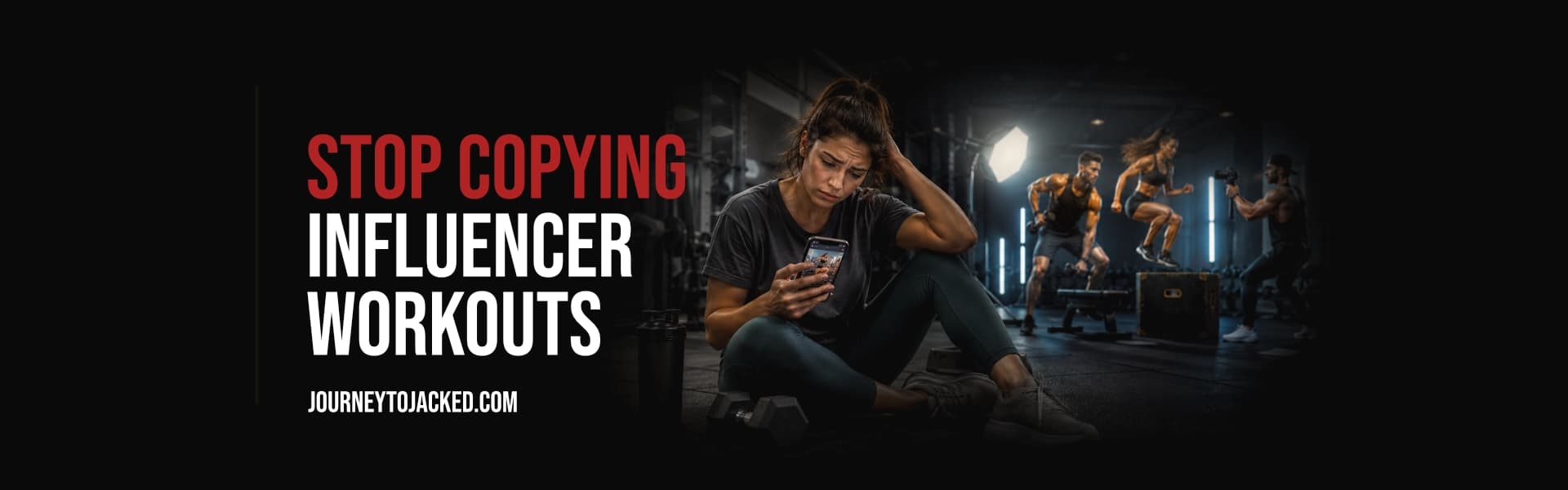
Why Beginners Should Stop Copying Influencer Workouts
Influencer workouts are built for views, not for your schedule, equipment, recovery, or goal. Here is why copying them stalls beginners.
You saved the workout. The one with the dramatic music and the perfect lighting. You tried it. Three weeks later, nothing changed.
That is not your fault. That workout was never built for you.
Influencer workouts are content first and training second. They are designed to hold attention for sixty seconds, not to build a beginner over twelve weeks. The two jobs are completely different.
Why don't influencer workouts work for beginners?
Influencer workouts fail beginners because they are designed for engagement, not adaptation. They ignore your schedule, your equipment, your recovery, your age, and your actual goal. A workout that performs well as content rarely performs well as training.
The video gets views because it looks intense, varied, and exciting. None of those traits build a beginner. Beginners need the opposite: simple, repeatable, and boring enough to actually progress on.
The Workout Was Made for the Camera, Not for You
Think about what a fitness video has to do. It has to look impressive in seconds. It has to feel fresh every single post. It has to keep you watching.
Now think about what a beginner program has to do. It has to fit your week. It has to use the gear you own. It has to let you recover and come back stronger.
Those are two different products. One is entertainment. One is a plan. You have been treating entertainment like a plan.
The influencer is not lying to you. They are just not training you. They are making content. You are the audience, not the client.
5 Things Influencer Workouts Ignore About You
A real plan is built around the person doing it. A viral workout cannot be, because the person doing it is a stranger. Here is what gets ignored every time.
1. Your Schedule
That six-day split looks great on screen. But you train four days a week, not six. Copy the split anyway and you either skip sessions or burn out trying to keep up. A plan has to fit the week you actually have.
2. Your Equipment
The video uses a cable machine, a hack squat, and three specialty bars. Your gym has none of them. Your home setup has a barbell and two dumbbells. Swapping random exercises mid-program breaks the structure the program needed.
3. Your Recovery
Influencers train as a full-time job. They sleep enough. They eat enough. They have years of training behind their joints and tendons. You have a desk job, broken sleep, and six months of lifting. Their recovery capacity is not yours.
4. Your Age
A 19-year-old recovers faster than a 45-year-old. That is biology, not weakness. Volume and frequency that work for a young influencer can leave an older beginner sore, stalled, and one bad rep from injury.
5. Your Goal
The video does not know if you want to lose fat, build muscle, or get stronger. So it tries to do all three at once. A plan that chases every goal makes progress on none. Your goal decides everything: the lifts, the reps, the rest, the volume.
Why Variety Looks Good but Slows You Down
Variety slows beginners down because progress comes from repeating lifts and adding load, not from changing exercises constantly. New movements feel exciting but reset your skill and strength on each one. Beginners grow fastest by doing fewer lifts more often.
Influencer content needs variety to survive. Nobody watches the same squat video forty times. So every post is a new "killer" exercise.
But your body does not grow from novelty. It grows from doing a hard thing again and again while slowly adding weight. The boring path is the fast path. Variety is a content strategy, not a training strategy.
If you cannot remember what you lifted last week, you cannot beat it this week. That is the whole problem with a feed full of random workouts.
What to Do Instead
Stop collecting workouts. Start running a plan. A plan and a workout are not the same thing.
A workout is one session. A plan is a structure that connects every session for weeks, built around you. Here is how to think like someone with a plan.
- Pick one goal. Fat loss, muscle, or strength. One. Decide before you train, not during.
- Train the days you actually have. Build the week around your real schedule, not the ideal one.
- Use the equipment you actually own. A plan built on your gear beats a perfect plan you cannot run.
- Repeat your main lifts. Keep the core movements stable. Add weight or reps. That is progress.
- Match volume to your recovery. Your sleep, your age, your stress. Train hard enough to grow, not so hard you stall. You can still watch the influencers. Learn form. Get ideas. Stay motivated. Just stop mistaking their content for your program.
What to Do Next
Get a plan built around you, not the algorithm. That means your stats, your goal, your equipment, and your real schedule on one page you can actually follow.
The J2J personalized fitness plan does exactly that. One structured PDF, engineered for your week and your goal. No guesswork. No random saved videos.
Stop copying. Start building. Get your personalized J2J plan.
Your Next Step
Stop guessing. Start building.
Get a personalised training plan built around your body, your goals, and your schedule — ready in minutes, yours forever.
Get Your Plan