
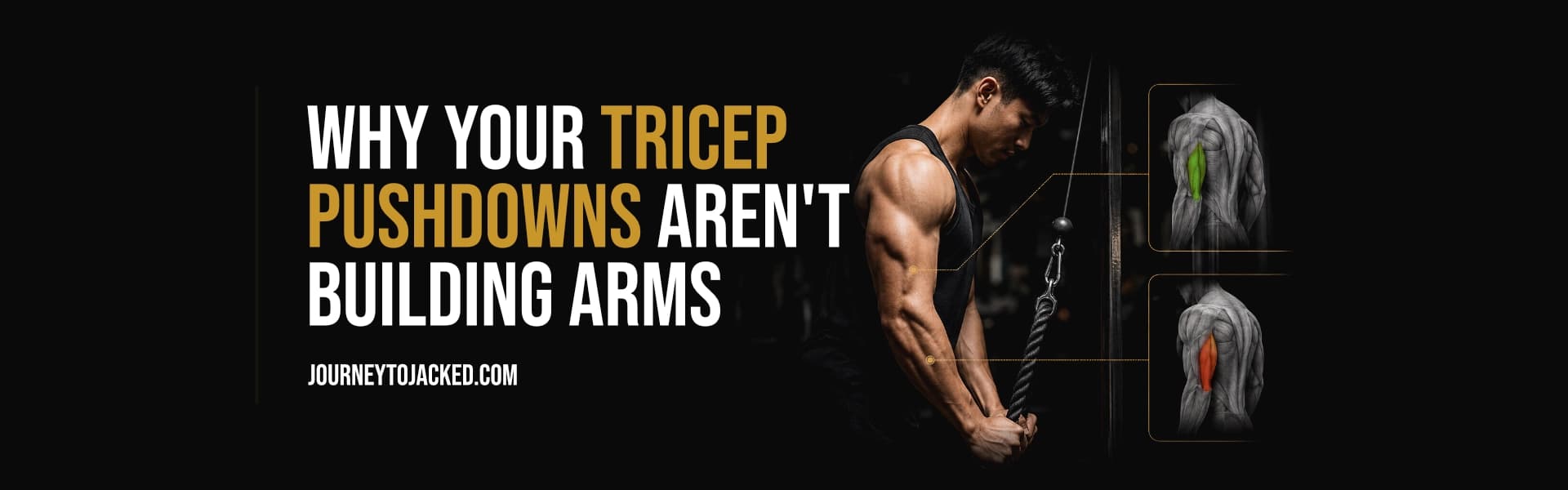
Why Your Tricep Pushdowns Aren't Building Arms
Your pushdowns aren't growing your arms because they skip the triceps long head. Here is the elbow and stretch fix that finally builds size.
You hammer pushdowns every push day. The stack goes up. Your arms look the same.
That is not bad luck. Your pushdowns are training the wrong part of your triceps.
The triceps have three heads. Pushdowns hit two of them well and neglect the biggest one. Fix that and your arms start growing. Below is why it happens and how to fix it.
Why aren't your tricep pushdowns building your arms?
Because pushdowns barely load the long head, the largest of your three triceps heads. Pushdowns train the lateral and medial heads with your arm down at your side. The long head only fully stretches when your arm is overhead. Skip overhead work and your biggest head stays small.
The triceps make up about two-thirds of your upper arm. Bigger arms come from bigger triceps, not more curls.
The long head is the mass. It runs down the back of your arm and gives you that thick, three-dimensional horseshoe. Starve it and your arms stay flat no matter how many sets you grind.
Why won't your triceps grow no matter how much you train?
It is not your genetics. It is your exercise selection. If every triceps movement you do keeps your arm at your side, you never train the long head in the position where it grows.
Most lifters assume pressing and pushing covers the triceps. It does not cover all three heads.
Bench, dips, and pushdowns all work the arm in a shortened or neutral position. None of them take the long head into a deep stretch. That gap is why your triceps stall while your effort stays high.
The fix is not more volume. It is the right position.
Why can't you feel your triceps during pushdowns?
Because your elbows are moving and your shoulders are taking over. The triceps do one job: they straighten your elbow. If your elbows drift forward or your torso pumps up and down, other muscles do the work and your triceps go quiet.
Watch for these tension leaks:
- Elbows drifting forward on every rep, turning it into a chest press
- Leaning and un-leaning to throw the weight down with momentum
- Shoulders shrugging up as the weight returns
- Too much load, forcing you to cheat the bar down
The weight on the stack means nothing if your triceps are not the muscle moving it. Strip the load and feel the muscle first.
Where should your elbows be on a tricep pushdown?
Pinned to your sides with your upper arms vertical. Your elbows are the hinge. They stay in one place while only your forearms move. That is the whole exercise.
Run this checklist on every set:
- Pin your elbows against your ribs and keep them there
- Lean forward slightly for leverage, then hold that angle
- Push down through your elbows, not your hands
- Lock out and squeeze hard at the bottom
- Fight the negative on the way up, do not let it yank your arms
Keep your traps relaxed and your shoulders down. If your elbows travel, the set is wasted. Drop the weight until they stay locked.
This is the same principle behind fixing any isolation lift. Your bicep curls fail for the same reason: momentum steals the tension the target muscle needs.
Do overhead tricep extensions build more triceps than pushdowns?
For the long head, yes. Training your triceps with your arm overhead grows the long head substantially more than training it with your arm at your side.
Researchers put this to the test. Lifters trained one arm overhead and the other in a neutral position for 12 weeks, matched for effort. MRI scans showed the long head grew far more in the overhead arm 1.
The reason is the stretch. Overhead, the long head is loaded at its longest, most stretched point. Training a muscle at long lengths drives more growth than training it short 2.
This is the same stretch-under-load logic that fixes the Romanian deadlift. Load the muscle where it is long and it grows.
Add one overhead movement to your week:
- Overhead cable extension for constant tension
- Overhead dumbbell extension for a deep stretch
- Incline skull crusher with the arms reaching back
Are tricep pushdowns a waste of time?
No. Keep them. Pushdowns are a solid finisher for the lateral and medial heads and they load the triceps hard with low joint stress.
The mistake is making them your only triceps work. Pushdowns build part of the arm. Overhead work builds the part you are missing.
Run both. Lead with an overhead movement while you are fresh, then finish with strict pushdowns. That combination trains all three heads and builds the full arm.
This is the same lesson as why your bench press isn't growing your chest. The lift is not the problem. The position is.
Your Next Step
Stop guessing. Start building.
Get a personalised training plan built around your body, your goals, and your schedule — ready in minutes, yours forever.
Get Your PlanReferences
Footnotes
-
Maeo, S., Wu, Y., Huang, M., Sakurai, H., Kusagawa, Y., Sugiyama, T., Kanehisa, H., & Isaka, T. (2023). Triceps brachii hypertrophy is substantially greater after elbow extension training performed in the overhead versus neutral arm position. European Journal of Sport Science, 23(10), 1240-1250. https://doi.org/10.1080/17461391.2022.2100279 ↩
-
Strey, B., Irigoyen, A., McMahon, G., & Pinto, R. S. (2026). Muscle hypertrophy from partial repetition at long vs. short muscle length: A systematic review and meta-analysis. Sport Sciences for Health, 22(1), Article 33. https://doi.org/10.1007/s11332-025-01586-5 ↩