
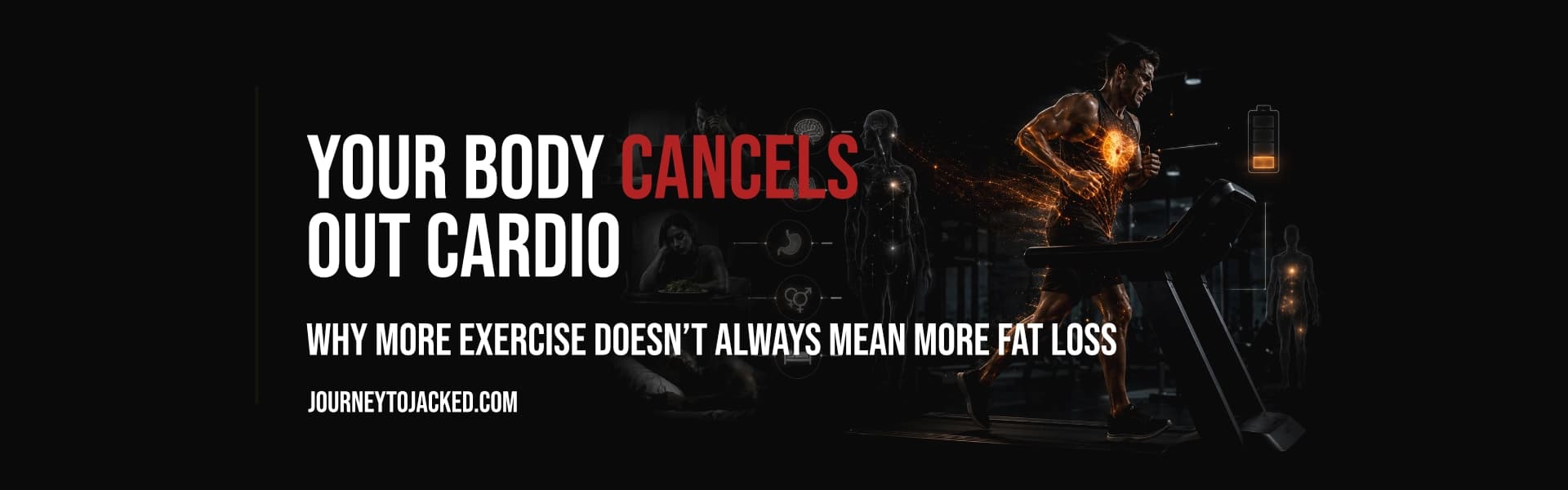
Your Body Cancels Out Cardio: Why More Exercise Doesn’t Always Mean More Fat Loss
Science shows your body cancels out extra cardio during a diet. Here is why fat loss is won at the plate, not the treadmill.
You added 45 minutes of cardio. The scale didn't move. Here's the science nobody told you.
A 2026 review in Current Biology confirms what frustrated dieters have felt for years. Your body fights back against extra exercise. It burns less energy elsewhere to cancel out part of what you torched on the treadmill.
This is the constrained energy expenditure model. Understand it, and you stop wasting hours on the wrong tool.
What is the constrained energy expenditure model?
The constrained model says total daily calorie burn does not rise endlessly with more exercise. Past a moderate activity level, your body holds total energy expenditure inside a narrow range by quietly cutting energy spent on other functions 1.
This breaks the math most people run. The old "additive" model assumes 300 calories of cardio means 300 extra calories burned that day. Reality is messier.
Your body is not a calculator. It is a survival machine. It adapts.
Your body compensates when you add exercise
When you push activity up, your body trims spending in the background. It dials down things like inflammation, stress response, and other non-essential processes 1.
You do not see this happen. You just see the scale stall.
The review is clear on one point though. Exercise still raises total burn. It just raises it less than the simple math predicts. The authors note that an increase in expenditure with activity was predicted and observed 1.
So cardio is not useless. It is just weaker at fat loss than you were sold.
Why does exercise burn fewer calories than expected during a diet?
Compensation hits hardest when you are in a calorie deficit. In a surplus your body burns close to the additive prediction. In a deficit it clamps down and protects its energy stores 1.
Read that again. The exact moment you want exercise to torch fat is the moment your body fights it most.
This is not a flaw in you. It is biology doing its job. Your body treats a deficit as a threat and defends itself.
The watch lied to you
Your fitness tracker says you burned 600 calories. Two problems.
- Trackers overestimate calorie burn. They are guesses dressed up as data.
- Even an accurate number ignores compensation. Your body already discounted that workout. Never eat back "exercise calories." You are eating phantom numbers.
How to actually lose fat: train hard, control intake
Fat loss is won at the plate. Not the treadmill. The deficit comes from what you eat, not what you sweat off.
That does not mean skip training. Training is non-negotiable. It just does a different job than you think.
Here is what lifting and smart training actually deliver:
- Muscle retention. A deficit strips weight. Training tells your body to keep the muscle and burn fat instead.
- Better body composition. Same scale weight, harder body. That is the win that matters.
- Health gains. The energy your body reclaims often comes from lower inflammation and stress load.
- Discipline reps. Showing up daily builds the identity. The body follows the habit. Stop using cardio as your fat-loss engine. Use it as a heart-health tool and a small calorie nudge. Build the deficit with food.
What to do next
Stop chasing burn. Start controlling intake.
Set your deficit through nutrition. Keep lifting to hold your muscle. Let the training build the body while the diet strips the fat.
Your Next Step
Stop guessing. Start building.
Get a personalised training plan built around your body, your goals, and your schedule — ready in minutes, yours forever.
Get Your PlanBuild the body. Own the journey.
References
Footnotes
-
Pontzer, H., & Trexler, E. T. (2026). The evidence for constrained total energy expenditure in humans and other animals. Current Biology, 36(4). https://doi.org/10.1016/j.cub.2026.01.025 ↩ ↩2 ↩3 ↩4