
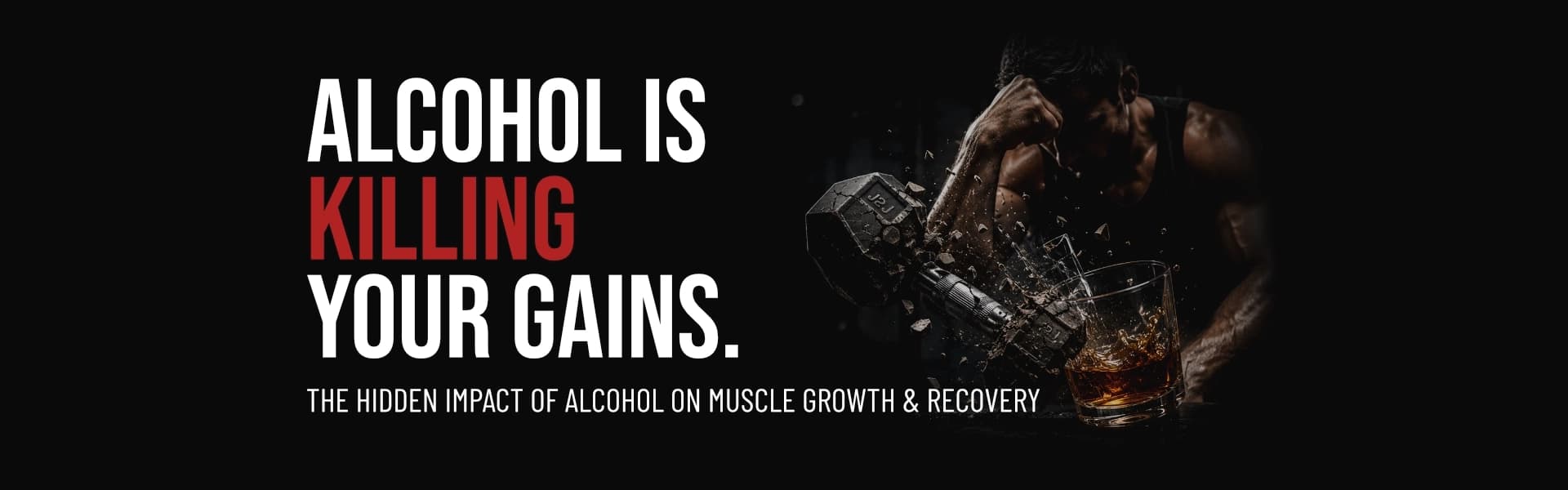
Alcohol and Muscle Growth: The Hard Truth
Every drink you take after the gym is quietly working against you — here's what the science says about alcohol and muscle growth.
You trained hard. You hit your macros. Then you cracked open a few drinks.
Here’s what you need to know: every sip was working against the gains you just earned. This isn’t gym bro folklore. The science is clear. Alcohol disrupts the very processes your body needs to build muscle. And if you’re serious about your physique, you need to understand exactly what’s happening inside your body when alcohol enters the picture.
Does Alcohol Kill Muscle Protein Synthesis?
Yes. This is the big one.
Muscle protein synthesis (MPS) is the process your body uses to repair and build new muscle tissue. After a hard training session, MPS spikes. That’s your window for growth. Alcohol slams that window shut.
A landmark study published in PLOS ONE found that consuming alcohol after a bout of exercise reduced myofibrillar protein synthesis rates by 24% — even when protein was consumed alongside the alcohol.1 That means your post-workout shake didn’t save you. The alcohol blunted it anyway.
The mechanism? Alcohol disrupts the mTOR signaling pathway — the primary molecular switch your body uses to trigger muscle protein synthesis.2 Alcohol inhibits the mTOR pathway, which is the predominant metabolic route controlling protein synthesis. When mTOR is suppressed, your body cannot efficiently translate the signal to build muscle, no matter how much protein you’ve eaten.
The research goes further. Both acute and chronic alcohol administration impairs translational control by modulating peptide-chain initiation, and this impairment is associated with a decreased availability of eukaryotic initiation factor 4E in striated muscle.3 In plain language: alcohol doesn’t just slow muscle building. It disrupts the machinery that starts the process.
How Much Alcohol Does It Take to Hurt Your Gains?
More than you think. Less than you’re hoping.
In one study examining the effects of alcohol on physically active males, there was a 37% reduction in muscle protein synthesis when 1.5g/kg of alcohol was consumed after exercise. Even when 20–30g of protein was consumed alongside alcohol, MPS was still reduced by 24%.1
For context, 1.5g/kg for a 180lb man is roughly 8 drinks. But the damage starts well below that threshold. Even moderate consumption triggers hormonal disruption that compounds over time.
The dose matters. Binge drinking causes the most acute damage. But regular moderate drinking — a few beers after training every week — accumulates into a chronic suppression of your growth environment.
Alcohol Wrecks Your Hormonal Profile
Muscle growth doesn’t happen without the right hormonal conditions. Alcohol attacks that environment from multiple angles.
Testosterone drops. A systematic review of studies on alcohol and post-exercise recovery found that testosterone levels decreased while cortisol levels increased following alcohol consumption.4 Testosterone is your primary anabolic hormone. Less of it means less muscle-building signal.
Cortisol spikes. Alcohol causes a significant elevation in the stress hormone cortisol.5 Cortisol is catabolic, meaning its presence encourages the breakdown of muscle tissue for energy. The combined effect of low anabolic hormones and high catabolic hormones promotes muscle wasting and fat storage.
HGH gets suppressed. Human Growth Hormone plays a crucial role in muscle repair and recovery, particularly during sleep. Drinking alcohol before bed suppresses HGH release, which means your body misses out on a critical window for muscle repair.4
The result is a hormonal environment that is the opposite of what a serious lifter needs. Low testosterone. High cortisol. Suppressed HGH. Three strikes against you before you even wake up the next morning.
Alcohol Destroys Sleep Quality
Sleep is when you grow. Not in the gym. In bed.
During deep sleep, your body floods the system with HGH and testosterone, repairs muscle tissue, and consolidates strength adaptations from training. Alcohol systematically destroys this recovery window.
Alcohol disrupts sleep cycles, particularly by reducing deep sleep, which diminishes the quality of rest and delays muscle regeneration.4
You might fall asleep faster after drinking. That’s sedation, not recovery. Your brain never reaches the deep stages where real repair happens. You wake up, feel groggy, and wonder why you’re not recovering between sessions. Now you know.
Dehydration Compounds Every Problem
Alcohol is a diuretic. It leads to dehydration, which hampers the circulation of essential nutrients for muscle repair.
Hydration is not optional for performance. Muscle tissue is roughly 75% water. Protein synthesis requires water. Nutrient transport requires water. Alcohol systematically pulls water from your cells while you sleep. You start the next training day already in a deficit.
Pair dehydration with disrupted sleep, suppressed testosterone, and blunted MPS — and you can see why alcohol has no place in a serious training protocol.
Does moderate drinking still hurt muscle growth?
This is the question most people want answered.
The honest answer: occasional, moderate drinking outside your post-workout window does the least damage. One study on moderate alcohol consumption found it did not impair overload-induced muscle hypertrophy in a controlled setting.6 But “controlled setting” and “Saturday night out” are very different things.
Timing alcohol consumption to avoid the post-exercise recovery window — typically the first few hours after exercise — can help mitigate its impact on muscle protein synthesis.
The practical rule: if you’re going to drink, make it infrequent, keep quantity low, and never drink in the post-workout window. Your body needs that window to grow.
If you’re chasing serious results — cuts, competition prep, strength PRs — alcohol has no favorable place in your protocol. Full stop.
The bottom line on alcohol and muscle growth
You don’t have to be perfect. But you need to be honest.
Every time you drink after training, you are:
- Cutting muscle protein synthesis by up to 37%
- Suppressing testosterone and HGH
- Spiking cortisol and promoting muscle breakdown
- Wrecking the deep sleep that is your primary recovery tool
- Dehydrating the tissue you just broke down and need to rebuild
The science doesn’t leave room for debate. Alcohol is anti-gains. What you do with that information is your call.
Build the body. Own the journey.
Your Next Step
Stop guessing. Start building.
Get a personalised training plan built around your body, your goals, and your schedule — ready in minutes, yours forever.
Get Your PlanSources
Footnotes
-
Parr, E.B., Camera, D.M., Areta, J.L., et al. (2014). Alcohol Ingestion Impairs Maximal Post-Exercise Rates of Myofibrillar Protein Synthesis following a Single Bout of Concurrent Training. PLOS ONE. https://www.ncbi.nlm.nih.gov/pmc/articles/PMC3922864/ ↩ ↩2
-
Lang, C.H., et al. (2015). Dysregulation of skeletal muscle protein metabolism by alcohol. American Journal of Physiology. https://journals.physiology.org/doi/full/10.1152/ajpendo.00006.2015 ↩
-
Lang, C.H., et al. (2001). Alcohol myopathy: impairment of protein synthesis and translation initiation. International Journal of Biochemistry & Cell Biology. https://www.sciencedirect.com/science/article/abs/pii/S1357272500000819 ↩
-
Vargas-Molina, S., et al. (2020). The Effects of Alcohol Consumption on Recovery Following Resistance Exercise: A Systematic Review. PMC. https://pmc.ncbi.nlm.nih.gov/articles/PMC7739274/ ↩ ↩2 ↩3
-
Haugvad, A., et al. (2014). Ethanol Does Not Delay Muscle Recovery but Decreases Testosterone/Cortisol Ratio. Medicine & Science in Sports & Exercise. https://www.researchgate.net/publication/261033811 ↩
-
Steiner, J.L. & Lang, C.H. (2015). Moderate alcohol consumption does not impair overload-induced muscle hypertrophy and protein synthesis. Physiological Reports. https://pmc.ncbi.nlm.nih.gov/articles/PMC4393167/ ↩