
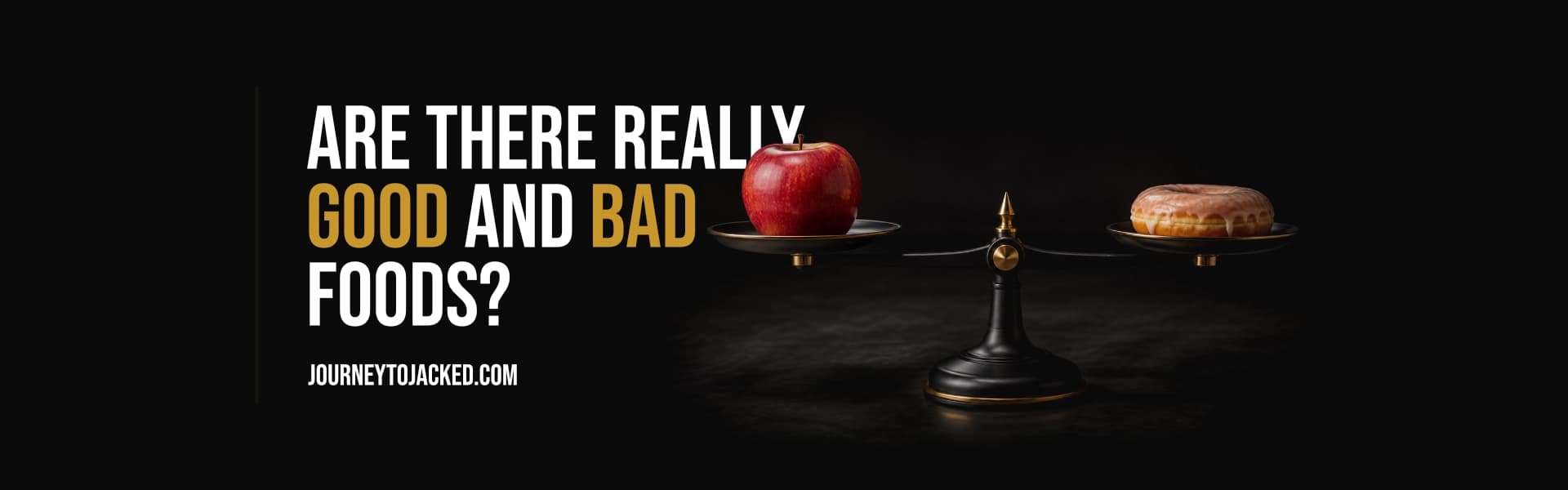
Are There Really Good and Bad Foods?
Food has no moral value, but it does have different jobs, and confusing the two is what stalls most lifters for years.
You ate the pizza. Now you are planning the punishment: extra cardio in the morning, skipped breakfast, back to chicken and rice by Monday.
The punishment plan does more damage than the pizza ever could.
We believe that food should not be sorted into good and bad. Food carries no moral weight. It does carry different jobs, and mixing those two ideas up keeps lifters stuck for years.
Are there really good and bad foods?
No. No single food makes you lean, and no single food makes you a bad person for eating it. Your body composition comes from total calories, protein intake, and how hard you train. Foods differ in how well they support those three things. That is a practical difference, not a moral one.
Look at the language the fitness world uses. Clean. Dirty. Cheating. Being good this week. Guilty pleasure.
Once you accept the frame, you are no longer managing a diet. You are managing a verdict on yourself.
Label a food bad, eat it anyway, and you have just broken a rule. Broken rules trigger the same thought in almost everyone: I already blew it, so the rest of the day does not count.
One slice becomes the whole pizza. Then the weekend. Then Monday.
Does it matter what you eat if the calories are the same?
Yes, but not for the reason most people think. Calories decide the direction of your body weight. Food choice decides whether you can actually hold those calories without white-knuckling it. Same math on paper, very different experience in real life.
A Kansas State nutrition professor made this point famously by dropping weight on a diet built around snack cakes, purely by keeping his calories low. The physics held up.
What that experiment does not tell you is how it felt at hour six with no protein and no volume in your stomach. That part is where the diet is actually won or lost.
Your food choices are not about purity. They are levers on hunger, energy, and recovery.
- Protein and fiber keep you full on fewer calories
- Whole foods take up more space in your stomach for the same energy
- Liquid calories slide past your fullness signals entirely
Why does junk food make a calorie deficit harder to hold?
Because it is easier to overeat without noticing. In a tightly controlled trial where meals were matched for calories, sugar, fat, sodium, and fiber, people ate roughly 500 more calories a day on the ultra-processed diet when allowed to eat as much as they wanted1.
Nobody in that study was told to eat more. They just did.
Worth knowing the limits: 20 people, two weeks per diet, living inside a research facility. Small and short. But the design was strong, and the mechanism it points at is one every lifter recognizes. Some food is engineered to be easy to keep eating.
That is a reason to build most of your intake around foods that fill you up. It is not a reason to fear a burger.
Can you build muscle while eating fast food?
Yes. Muscle needs enough total calories, enough protein, and a training stimulus that forces adaptation. A drive-through meal can supply calories and protein. What it usually will not supply is the fiber, micronutrients, and fullness that make the rest of your week manageable.
The lifters who get this wrong go one of two ways. Some use it as licence for a sloppy bulk and end up burying the muscle they built. Others refuse anything they did not weigh at home and quit in six weeks.
If you are bulking, the split matters more than the source of any single meal. We break the numbers down in lean bulk vs dirty bulk.
Will one cheat meal ruin your progress?
No. One large meal is a rounding error across a week of eating. You might see the scale jump two or three pounds the next morning, and almost all of that is water and food volume moving through you, not fat you gained overnight.
The meal is not what does the damage. The spiral afterward is.
Guilt is what turns one dinner into a five-day write-off. You feel like you failed, so you stop tracking, stop caring, and wait for a fresh start that never quite arrives. Then you brand yourself as someone with no discipline, which is nonsense. You just installed a rule designed to be broken.
Why do people feel guilty after eating junk food?
Because they were taught that food choices measure character. Eat the salad, you are disciplined. Eat the donut, you are weak. That framing does not make anyone leaner, and rigid all-or-nothing dieting has been linked to more overeating episodes than flexible approaches2.
Rigid dieting also does not outperform the flexible version where it counts. When resistance-trained lifters were randomized to either a strict set meal plan or a flexible macro target during a 10-week deficit, both groups lost the same fat3.
Same result. One approach costs you your weekends and your sanity.
If food guilt has moved past irritation into something that dominates your day, that is worth taking to a professional rather than a training article. There is no shame in that, and no amount of macro math fixes it.
What is the 80/20 rule for eating?
Build roughly 80% of your intake from foods that hit your protein, fiber, and fullness targets. Spend the other 20% on whatever you actually want to eat. It is a ratio, not a rule, so a heavy weekend does not fail you. It just gets averaged in.
Nobody hits 80/20 on a given day. You hit it across a month.
Two things make it work in practice:
- Know your numbers first. Run your intake through the macro calculator or calculate your calories by hand so the 20% has a budget instead of being a guess.
- Do not schedule the 20% in advance. Life fills it for you: a birthday, a work dinner, a Friday you did not plan.
How to stop labeling your food and still get lean
Drop the courtroom vocabulary. No clean, no dirty, no cheating. Swap the question from "is this food good" to "does this food do the job I need right now."
Before a heavy session, you need fuel. On a hard cut, you need volume and protein. At your kid's birthday, you need a slice of cake and no commentary about it afterward.
Eat like an adult with a goal. Then go train.
Your Next Step
Stop guessing. Start building.
Get a personalised training plan built around your body, your goals, and your schedule — ready in minutes, yours forever.
Get Your PlanReferences
Footnotes
-
Hall, K. D., et al. (2019). Ultra-processed diets cause excess calorie intake and weight gain: An inpatient randomized controlled trial of ad libitum food intake. Cell Metabolism, 30(1), 67–77.e3. https://doi.org/10.1016/j.cmet.2019.05.008 ↩
-
Smith, C. F., Williamson, D. A., Bray, G. A., & Ryan, D. H. (1999). Flexible vs. rigid dieting strategies: Relationship with adverse behavioral outcomes. Appetite, 32(3), 295–305. https://doi.org/10.1006/appe.1998.0204 ↩
-
Conlin, L. A., Aguilar, D. T., Rogers, G. E., & Campbell, B. I. (2021). Flexible vs. rigid dieting in resistance-trained individuals seeking to optimize their physiques: A randomized controlled trial. Journal of the International Society of Sports Nutrition, 18, 52. https://doi.org/10.1186/s12970-021-00452-2 ↩