
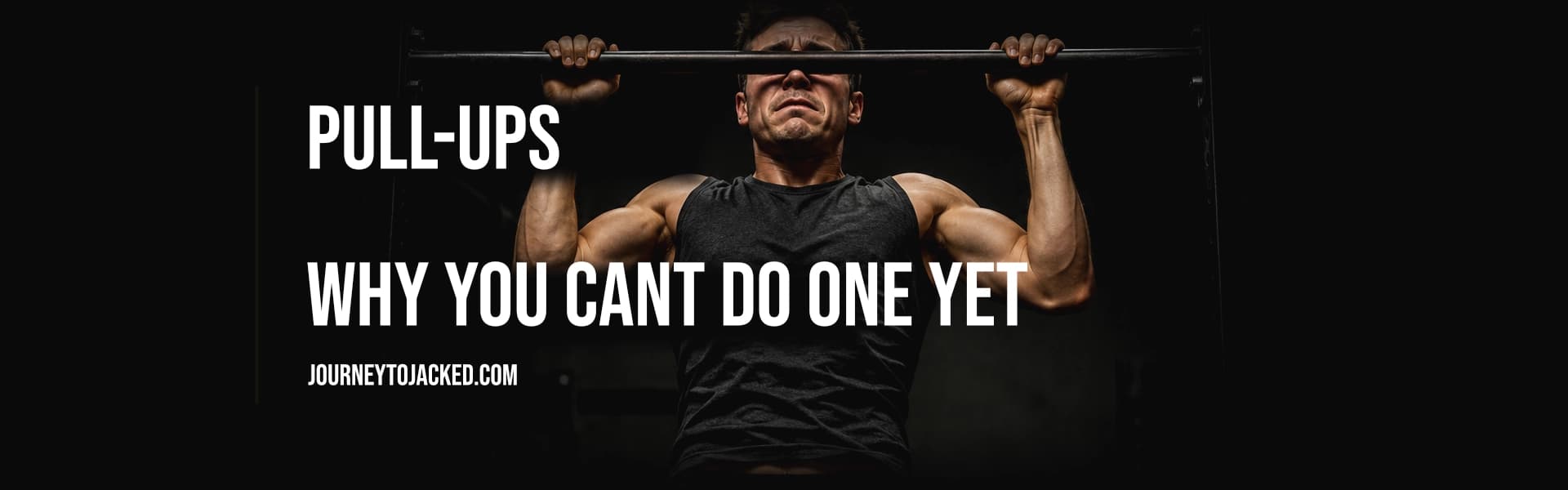
Pull-Ups: Why You Can't Do One Yet (And the Fix)
Can't do a single pull-up yet? It's a missing strength base, not a willpower problem. Here's the dead-hang-to-first-rep progression that fixes it.
You grab the bar, you pull, and nothing moves. Your chin stays a foot below the bar and your arms shake. Sound familiar?
You are not weak and you are not broken. The pull-up is a skill built on a strength base most people have never trained directly. The good news: it is trainable on a schedule, and the path from a dead hang to your first clean rep is short once you stop guessing.
This is the fix.
Why can't I do a pull-up yet?
You can't do a pull-up yet because pulling your full bodyweight needs lat strength, grip endurance, and scapular control most people never train. It is not a willpower problem. It is a missing strength base plus an untrained movement pattern, and both fix fast with the right progression.
Here is the part nobody tells you. A pull-up asks you to move your entire bodyweight through space using muscles you barely use in daily life. If you have spent years sitting, your lats, mid-back, and grip have never been asked to do this job.
That is not a character flaw. It is just an untrained pattern.
The 4 reasons your pull-up is stuck
Most failed pull-ups come down to four fixable gaps. Find yours.
- Weak lats. The latissimus dorsi is the prime mover in a pull-up. If you can't feel your back working, the muscle isn't contributing and your arms are doing a job they are too small to finish.
- No grip endurance. If your hands give out before your back does, the set ends early. Grip is the first link in the chain, and a weak link breaks the whole pull.
- No scapular control. A pull-up starts by pulling your shoulder blades down and back. Skip this and you hang from your joints, not your muscles.
- Bodyweight to strength ratio. Carrying extra fat means more load on every rep. Building strength while staying lean tilts the math in your favor. If this is your gap, start with the skinny fat fix.
Pick the one that sounds most like you. That is where your training starts.
The dead-hang-to-first-rep progression
Master each step before moving to the next. The rule is simple: hit the rep target with clean form, then advance. No skipping.
Step 1: Dead hang
Hang from the bar with straight arms and shoulders engaged. Not slack, not shrugged to your ears. Pull your shoulders down slightly and hold.
This builds the grip endurance and shoulder stability every later step needs.
Target: hold for 30 seconds before moving on.
Step 2: Scapular pulls
From a dead hang, pull your shoulder blades down and back without bending your elbows. Your body rises an inch or two. Lower under control.
This teaches the exact movement that starts every pull-up. Most people have never felt it.
Target: 3 sets of 8 to 10 clean reps.
Step 3: Inverted rows
Set a bar at waist height. Hang underneath it with your body in a straight line and pull your chest to the bar. The more horizontal you are, the harder it gets.
This builds back and arm strength in the same pulling pattern, with less load than a full pull-up.
Target: 3 sets of 10 to 12 reps.
Step 4: Negative pull-ups
Jump or step to the top position with your chin over the bar. Then lower yourself as slowly as you can. Aim for a 3 to 5 second descent.
This is the most important step. You are stronger lowering a weight than lifting it, so you can train the full pull-up movement before you can do one going up.
This is where the science earns its keep. Eccentric training, the lowering half of a lift, drives large gains in muscle strength, and those gains are often greater than training the lifting half alone 1. Negatives let you load the exact movement you are chasing.
Target: 3 to 5 sets of 3 to 5 slow negatives.
Step 5: Band-assisted pull-ups
Loop a resistance band over the bar and put one foot or knee in it. The band gives you a boost at the bottom, where the pull is hardest. Move to a lighter band as you get stronger.
Target: 3 sets of 5 to 8 reps, then drop to a lighter band.
Work these in order, two to three sessions a week, and the first unassisted rep stops being a someday goal.
How long does it take to get your first pull-up?
Most beginners get their first unassisted pull-up in 8 to 12 weeks of consistent training. Lighter, stronger starters can do it in 4 to 6 weeks. Heavier beginners or those new to upper-body work may need 3 to 6 months. Bodyweight, training age, and consistency set the pace.
The single biggest variable is consistency. Three focused sessions a week beats six random ones. You do not need to live in the gym either. Here is how to build muscle on three days a week when time is tight.
The lifters who get there fastest are not the most talented. They are the ones who showed up and ran the progression without skipping steps.
What muscles do pull-ups work?
Pull-ups primarily work the latissimus dorsi, the large muscles of your back. They also train the biceps, forearms and grip, the rear shoulders, the mid-back, and the core, which stabilizes your body against swinging. It is one of the most complete upper-body movements you can train.
This is why the pull-up is worth the effort. Few movements train this much of your upper body in a single rep. Build the pull-up and you build a back, arms, and grip that carry over to almost everything else you do.
Why negative pull-ups beat the assisted machine
The assisted pull-up machine pushes you up from the bottom and removes load from the part of the movement you most need to strengthen. It feels productive, but it lets you avoid the hard part.
Negatives do the opposite. They load the full range and force your muscles to control your real bodyweight. Eccentric loading is one of the most effective tools for building the strength a pull-up demands 1, and it transfers directly because you are training the actual movement.
Use bands or negatives over the machine when you can. The machine is a fallback, not a first choice.
Build the pull, own the bar
Your first pull-up is not a talent test. It is a strength base plus a trained pattern, built in order, on a schedule. Dead hang, scapular pulls, rows, negatives, bands. Run the steps. Show up two to three times a week. The rep will come.
Stop guessing which step you are on and how to program it. A plan built around your bodyweight, your equipment, and your schedule removes the guesswork and gets you to the bar faster.
Your Next Step
Stop guessing. Start building.
Get a personalised training plan built around your body, your goals, and your schedule — ready in minutes, yours forever.
Get Your PlanReferences
Footnotes
-
Roig, M., O'Brien, K., Kirk, G., Murray, R., McKinnon, P., Shadgan, B., & Reid, W. D. (2009). The effects of eccentric versus concentric resistance training on muscle strength and mass in healthy adults: a systematic review with meta-analysis. British Journal of Sports Medicine, 43(8), 556–568. https://doi.org/10.1136/bjsm.2008.051417 ↩ ↩2