
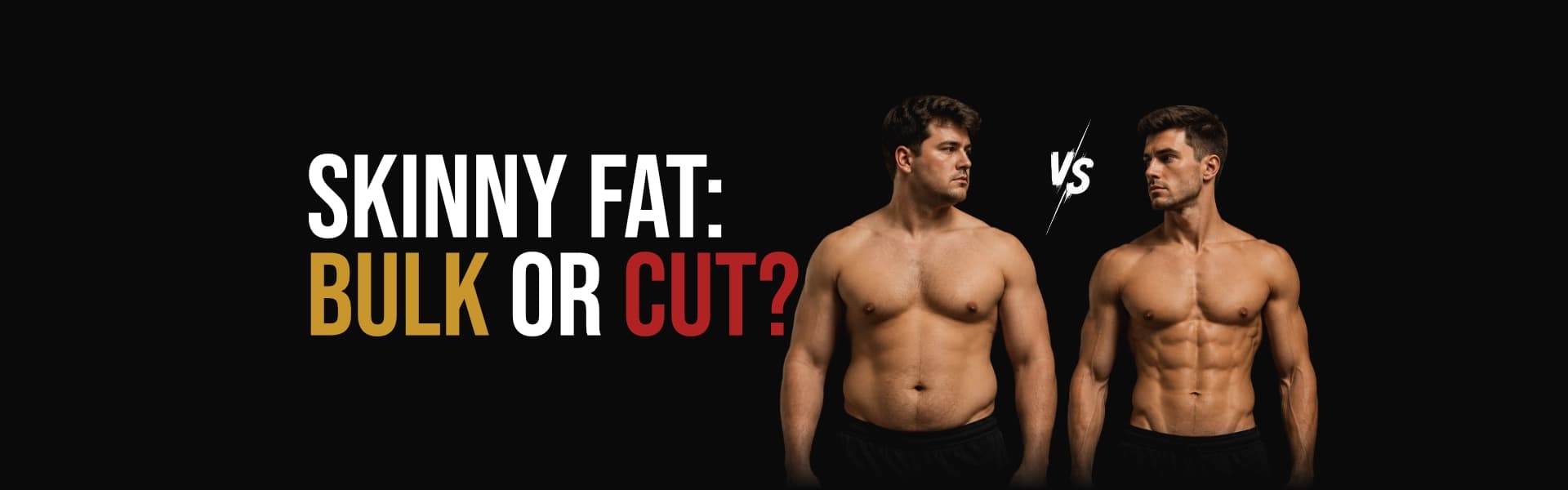
Skinny Fat: Bulk or Cut? The Honest Answer
Skinny fat and stuck between bulking and cutting? Here’s the evidence-based framework to pick the right path, backed by peer-reviewed research.
You look skinny in a shirt and soft without one. The scale lies. The mirror tells the truth.
So now you’re stuck on the question every skinny fat lifter asks: bulk or cut?
The answer isn’t a coin flip. It depends on your body fat, your training history, and what the actual research says. This post gives you the framework. No fluff. No bro-science. Just peer-reviewed evidence and a clear path forward.
What Does Skinny Fat Mean?
Skinny fat describes someone at a “normal” body weight who carries too much fat and not enough muscle. Low scale weight. High body fat percentage. Zero definition.
You’re not overweight. You’re under-built. And research shows this profile is the easiest to fix.
Should a Skinny Fat Person Bulk or Cut?
The short answer: it depends on body fat percentage and training history. Skinny fat beginners can build muscle and lose fat at the same time, a phenomenon researchers call body recomposition 1. More advanced lifters typically need to pick one focus at a time.
The science settles the debate. Here’s how to apply it.
The case for body recomposition first when skinny fat
Can Skinny Fat People Build Muscle and Lose Fat Simultaneously?
Yes. A 2020 peer-reviewed review in the Strength and Conditioning Journal concluded that body recomposition is achievable across multiple populations, including untrained, overweight, and even resistance-trained individuals 1. Skinny fat beginners are the prime candidates because they’re under-muscled and have fat to spare.
In short: your starting point is your biggest advantage.
What Does the Landmark Study Show?
The clearest evidence comes from a 2016 randomized trial published in the American Journal of Clinical Nutrition by Longland and colleagues 2. Forty young men trained hard for 4 weeks in a 40% caloric deficit. The high-protein group (2.4 g/kg/day) lost 4.8 kg of fat and gained 1.2 kg of lean mass. The lower-protein group (1.2 g/kg/day) lost 3.5 kg of fat and maintained lean mass.
Fat down. Muscle up. In a deficit. Done.
Why It Works for Skinny Fat Specifically
The mechanism is simple. With high protein and progressive resistance training, your body protects and builds muscle while pulling energy from fat stores 1. Skinny fat lifters have stored fat to burn and untapped muscle-building potential.
That’s why beginners often see the fastest physique transformations of their lives.
The case for bulking first when skinny fat
When Should You Bulk Instead of Recomp?
Bulk first if you’re already relatively lean but underdeveloped. If you have low body fat and minimal muscle, a small caloric surplus gives your body the energy to build new tissue. Recomp slows down once your fat stores are limited.
The leaner you start, the more sense bulking makes.
How Big Should the Surplus Be?
Keep it small. A modest surplus of around 200 to 300 calories above maintenance is enough to drive muscle growth without piling on fat. Aggressive surpluses don’t build more muscle. They just build more fat.
Slow gains. Lean gains. That’s the goal.
How Much Protein Do You Need?
A 2018 meta-analysis in the British Journal of Sports Medicine by Morton et al. pooled data from 49 studies and 1,863 participants 3. The break-point analysis identified 1.62 g/kg/day as the threshold past which additional protein produced no further gains in fat-free mass.
Aim for 1.6 to 2.2 g/kg/day. Going higher is fine but not magic.
The case for cutting first when skinny fat
When Should You Cut Before Anything Else?
Cut first if your body fat is high enough that bulking would put you in a deeper hole. The Longland trial showed that even in a 40% deficit, a high-protein group still gained 1.2 kg of lean mass while losing nearly 5 kg of fat 2. You don’t need a surplus to start building.
If you’re soft, prioritize getting leaner first.
What Does Cutting Properly Look Like?
Three things, all evidence-based:
- High protein: at least 1.6 g/kg/day, with 2.2 to 2.4 g/kg/day showing superior fat loss and muscle retention under aggressive deficits 2 3.
- Resistance training: this is non-negotiable. Lifting in a deficit preserves and even builds muscle while driving the fat loss 1 2.
- Modest deficit: aim for 0.5 to 1% of body weight per week. Faster than that and you risk losing muscle alongside fat.
Slow and steady. No starvation diets.
What the Research Doesn’t Support
You don’t need:
- Long fasts
- Carb cycling for beginners
- Two-hour daily workouts
- Six small meals a day to "stoke metabolism"
You need protein, progressive overload, and 12 weeks of discipline.
How to decide whether to bulk or cut when skinny fat
Use this hierarchy to choose your path. It’s built directly from the studies cited above.
| Profile | Recommended Path | Why |
|---|---|---|
| Skinny fat beginner, new to lifting | Recomp | Body recomp works best in untrained skinny fat lifters 1 |
| Lean but underdeveloped (under 15% BF men, 23% women) | Lean bulk | Small surplus with 1.6 g/kg protein maximises muscle gain 3 |
| Higher body fat, soft midsection | Cut first | High-protein deficit drops fat and preserves muscle 2 |
The numbers are guidelines. The discipline is the variable.
Why Most Skinny Fat Lifters Get This Wrong
They flip-flop. Two weeks of bulking. Two weeks of cutting. Zero progress in either direction.
You don’t need a perfect plan. You need a plan you’ll stick to for 16 weeks.
Discipline beats optimization. Always.
What to Do Next
Pick one path today. Recomp, bulk, or cut. Set protein at 1.6 to 2.2 g per kg of body weight. Train with progressive resistance four times this week.
Then check back in 12 weeks. Not three days. Not three weeks. Twelve.
Need help with a plan that fits your goals, gym equipment and your life's busy schedule? 60-second quiz and build your personalized pdf plan - no subscription.
Your Next Step
Stop guessing. Start building.
Get a personalised training plan built around your body, your goals, and your schedule — ready in minutes, yours forever.
Get Your PlanWant the full skinny fat playbook? Read Skinny Fat Fix: How to Build Muscle and Lose Fat at the Same Time for the complete protocol.
References
Footnotes
-
Barakat, C., Pearson, J., Escalante, G., Campbell, B., & De Souza, E. O. (2020). Body Recomposition: Can Trained Individuals Build Muscle and Lose Fat at the Same Time? Strength and Conditioning Journal, 42(5), 7-21. DOI: 10.1519/SSC.0000000000000584 ↩ ↩2 ↩3 ↩4 ↩5
-
Longland, T. M., Oikawa, S. Y., Mitchell, C. J., Devries, M. C., & Phillips, S. M. (2016). Higher compared with lower dietary protein during an energy deficit combined with intense exercise promotes greater lean mass gain and fat mass loss: a randomized trial. American Journal of Clinical Nutrition, 103(3), 738-746. DOI: 10.3945/ajcn.115.119339 ↩ ↩2 ↩3 ↩4 ↩5
-
Morton, R. W., Murphy, K. T., McKellar, S. R., Schoenfeld, B. J., Henselmans, M., Helms, E., Aragon, A. A., Devries, M. C., Banfield, L., Krieger, J. W., & Phillips, S. M. (2018). A systematic review, meta-analysis and meta-regression of the effect of protein supplementation on resistance training-induced gains in muscle mass and strength in healthy adults. British Journal of Sports Medicine, 52(6), 376-384. DOI: 10.1136/bjsports-2017-097608 ↩ ↩2 ↩3