
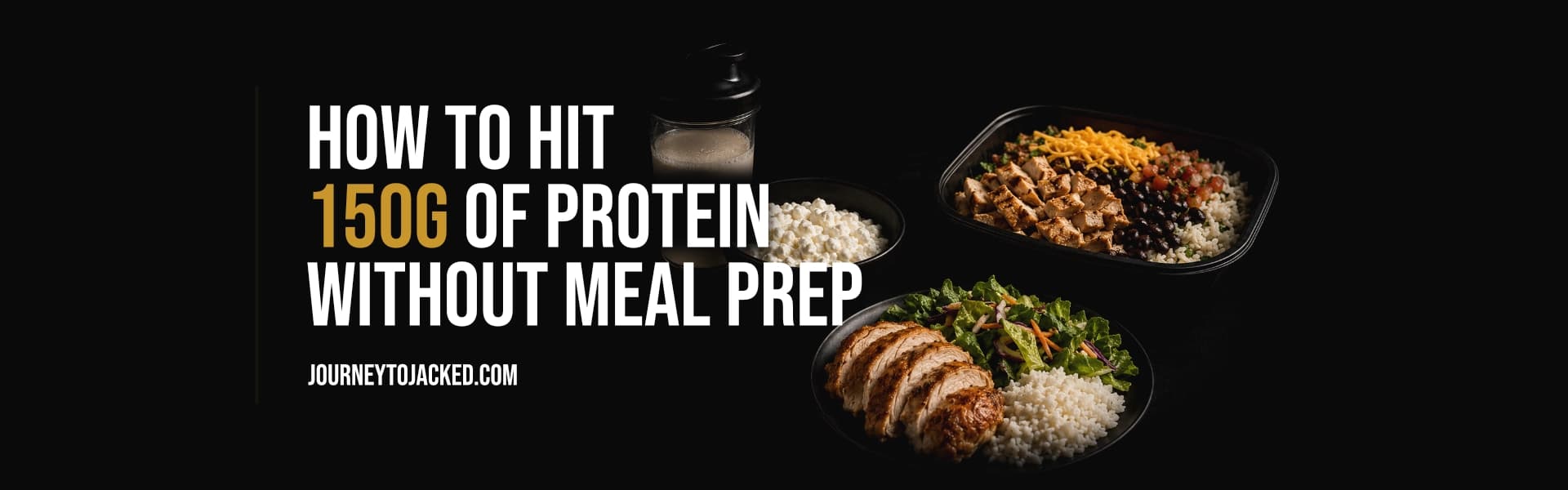
How to Hit 150g of Protein Without Meal Prep
Hit 150g of protein a day with three anchor meals, no Sunday batch cooking, and a worked example you can copy tomorrow.
It is 9pm, you are 60 grams short, and the fridge has condiments and a lime in it. Tomorrow you will do the same thing.
Most protein advice assumes you have a free Sunday. Six meals, three snacks, containers stacked in the fridge. Nobody holding down a full-time job and a family keeps that running past week two.
Forget the containers. Three anchor meals is the whole system.
How much protein do you actually need each day?
For most lifters, around 1.6 grams of protein per kilogram of bodyweight per day is a strong target for maximizing muscle growth. A meta-analysis of 49 studies involving 1,863 participants found that additional protein was not associated with greater gains in fat-free mass beyond an estimated intake of roughly 1.62 g/kg per day 1. For a 90 kg, or 200 lb, man, that works out to about 150 grams of protein.
The one-gram-per-pound rule is not wrong. It is simply the upper end of the useful range presented as the minimum. If you weigh 200 pounds, a practical target is roughly 150 to 180 grams per day. Eating 200 grams is unlikely to hurt, but it probably will not build noticeably more muscle either.
For the full breakdown by bodyweight and goal, read how much protein you actually need to build muscle.
150 grams is the working number for the rest of this post.
Can your body only use 30 grams of protein per meal?
No. A 2023 tracer study found that 100 grams of protein in one sitting produced a larger and longer muscle-building response than 25 grams, with no ceiling detected across 12 hours 2. The 30 gram rule came from studies that stopped measuring too early.
That study used recreationally active young men and a single dose, so treat it as a ceiling-raiser, not a licence to eat once a day. But the practical point holds: your 70 gram dinner is not wasted.
This is the fact that frees your schedule. If 30 grams were really the cap, you would need five feedings and the meal prep everyone tells you to do. Since it is not, three larger meals work. Meal frequency barely moves the needle on muscle anyway, which is covered in how many meals a day build muscle.
Stop spreading protein thin. Stack it.
How do you get 150 grams of protein in three meals?
Three anchors of roughly 50 grams each. Here is a real day with no stove, no containers, and no weekend prep.
| Anchor | What you eat | Protein |
|---|---|---|
| 7:10am, 3 minutes | 1 cup 2% cottage cheese + 1 scoop whey in water | 50 g |
| 12:40pm, bought | Burrito bowl: chicken, black beans, rice, cheese, no tortilla | 52 g |
| 7:30pm, 5 minutes | 5 oz supermarket rotisserie chicken + bagged salad + microwave rice | 48 g |
| Total | 150 g |
Zero pans. One of the three meals you bought at a counter. The other two are assembly, not cooking.
The whole system rests on one habit: shop for protein blocks, not recipes. A rotisserie chicken, a tub of cottage cheese, and a bag of salad is a week of dinners.
30-gram blocks you can build a day from
Pick three or four of these and you are at your number:
- 5 oz supermarket rotisserie chicken: 43 g
- High-protein bottled shake: 30 to 42 g
- 1 cup 2% cottage cheese: 25 g
- 1 scoop whey: 25 g
- 1 cup plain Greek yogurt: 23 g
- Two tuna or salmon pouches: 34 g
- 4 oz deli turkey: 24 g
- 3 oz beef jerky: 30 g
- Two hard-boiled eggs + two string cheese: 26 g
A shake is a delivery method. It counts the same as chicken, which is the honest case for and against powder in do you actually need protein powder.
What if you only get two meals in?
Split it 75 and 75. On a travel day or a back-to-back meeting day, two 75 gram meals beat a perfect five-meal plan you did not execute. The research above says those large doses still get used.
Do not skip the day because you cannot run it properly. Run it smaller.
Why does your protein total come up short by dinner?
Because you back-load it. A carb-heavy breakfast and a light lunch leave 110 grams to make up after 7pm, and nobody eats 110 grams of protein when they are tired and already full.
Miss breakfast and you are already 50 grams down before your first meeting. That gap never closes.
Fix the arithmetic and the willpower stops mattering. Get 50 grams in before 10am and the rest of the day takes care of itself.
How do you hit a protein target when lunch is a restaurant?
Order the protein first and build around it. A bowl with double meat and no tortilla clears 60 grams. Most sit-down mains land at 35 to 45 grams if you skip the bread and take the sauce on the side.
Four rules that hold anywhere:
- Pick the animal first. Grilled, roasted, or blackened. Never fried, because breading buys calories and adds nothing.
- Double the protein. It is usually the cheapest upgrade on the menu.
- Drop the vehicle. Bowl instead of wrap, no bun, no chips.
- Memorise two orders. One at your regular lunch spot, one at the airport. Decision fatigue is what kills the target.
You can eat out five days a week and still hit 150. You just have to order like you mean it.
What to Do Next
Set your number, buy four protein blocks, and get 50 grams down before 10am tomorrow. That single change closes most of the gap on its own.
Guessing runs low every time. Your target depends on your bodyweight, your training, and the schedule you actually have, and a generic 150 is only right for some of you.
Get the number built around your stats, your equipment, and your week. Then eat to it.
Your Next Step
Stop guessing. Start building.
Get a personalised training plan built around your body, your goals, and your schedule — ready in minutes, yours forever.
Get Your PlanReferences
Footnotes
-
Morton, R. W., Murphy, K. T., McKellar, S. R., et al. (2018). A systematic review, meta-analysis and meta-regression of the effect of protein supplementation on resistance training-induced gains in muscle mass and strength in healthy adults. British Journal of Sports Medicine, 52(6), 376-384. https://doi.org/10.1136/bjsports-2017-097608 ↩
-
Trommelen, J., van Lieshout, G. A. A., Nyakayiru, J., et al. (2023). The anabolic response to protein ingestion during recovery from exercise has no upper limit in magnitude and duration in vivo in humans. Cell Reports Medicine, 4(12), 101324. https://doi.org/10.1016/j.xcrm.2023.101324 ↩