
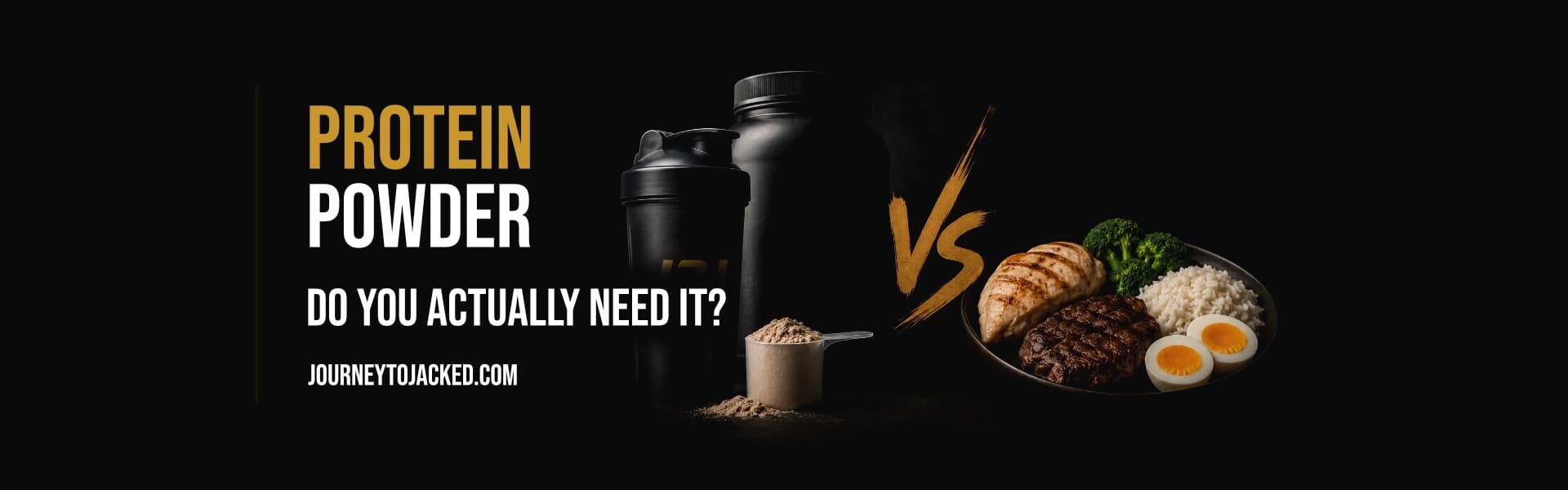
Protein Powder: Do You Actually Need It?
Protein powder does not build muscle better than food. Here is when it earns a place in your diet and when it is just expensive convenience.
No. You do not need protein powder to build muscle.
That is the honest answer, and the supplement industry has spent four decades and billions of dollars making sure you never hear it stated that plainly.
But the answer does not end there. Because the reason most lifters buy powder is not that they believe it is magic. It is that they keep missing their protein target by Thursday and they need something to close the gap. That is a real problem. Powder is one real solution.
Here is when it earns its place in your kitchen, and when it is just expensive convenience.
How much protein do you actually need in a day?
Between 1.6 and 2.2 grams per kilogram of bodyweight per day. A meta-analysis of 49 studies and 1,863 participants found that gains in fat-free mass plateau at about 1.62 g/kg/day, with the confidence interval reaching 2.2 1. For a 180 lb lifter, that is roughly 130 to 180 grams.
Worth noting that one author of that meta-analysis later disclosed an advisory role with a supplement manufacturer. The finding still holds up because it has been replicated elsewhere, but you should know who is standing behind the numbers you are handed. That applies to every protein claim you read, including this one.
That number is the whole game. Not the source. Not the timing. The number.
Most lifters who feel like they need powder have never actually counted. They assume they are short. Count first for one honest week. You may already be at 140 grams and buying a tub you do not need.
If you want the full breakdown of where that range comes from and how to set yours, read how much protein you actually need to build muscle. Then run your numbers through the macro calculator.
Does protein powder build muscle better than whole food?
No. No trial has ever shown protein powder beating whole food for muscle growth when total protein is equal. Total daily intake is what drives growth, not the container it arrives in.
Here is the part that should make you suspicious of the marketing. There is no long-term trial directly comparing protein powder against whole food at matched protein intakes. It has not been run. The industry has had four decades and enormous budgets, and the study that would prove powder superior does not exist.
What we do have is a large body of trials comparing one protein source against another. A 2021 meta-analysis of 16 randomised controlled trials found protein source did not significantly affect absolute lean mass or muscle strength 2. The authors did find a small edge for animal protein on percent lean mass, and a modest lean mass advantage in adults under 50, so this is not a clean "everything is identical" result. But nothing in it points toward isolated powder.
The "fast absorption" argument gets sold hard because it sounds scientific. Whey does digest faster and spike leucine higher. That is real physiology, and it has never been shown to produce more muscle over months of training. Your body assembles tissue over days, not minutes.
Powder is not better. It is protein in a format that fits in a gym bag.
Is there lead in protein powder?
Often, yes, at trace levels. Consumer Reports tested 23 protein powders and shakes in 2025 and found more than two thirds carried more lead in one serving than its experts consider safe for a full day. The Clean Label Project tested 160 products and found 47% exceeded California Proposition 65 thresholds. Plant-based powders were worst by a wide margin.
The gap between sources is the useful part. Consumer Reports found plant-based powders averaged around nine times the lead of dairy-based ones. If you take one thing from this section, take that.
Now the context that stops this from being a panic. Both thresholds are strict by design. Consumer Reports set its level of concern at 0.5 micrograms per day, derived from Prop 65, which is among the most conservative standards anywhere. The supplement trade body argued that exceeding a self-selected threshold is not the same as exceeding a government limit, and on that narrow point they are correct. Consumer Reports' own reporter said even the worst products sit far below the level needed to cause immediate harm.
The real problem is the regulatory vacuum behind all of it. There are no enforceable federal limits on heavy metals in supplements. The FDA publishes interim reference levels, 8.8 micrograms of lead per day for women of childbearing age, but those are targets for industry, not requirements. Supplements are not tested or verified before they reach shelves. Manufacturers test themselves.
So the risk is not one shake. It is daily use for years with nobody checking. Handle it like this:
- Buy NSF Certified for Sport or Informed Sport certified products only
- Choose dairy-based over plant-based unless you have a reason not to
- Skip anything carrying a Prop 65 warning label
- Do not run three scoops a day just because the tub is big
Worth knowing that Consumer Reports still rated 7 of its 23 products as fine for daily use. This is a shopping problem, not a reason to swear off powder.
Whole food does not need a certification badge. That is a real advantage, and nobody selling powder will mention it. The same third-party testing logic applies to every supplement you buy, covered in the magnesium supplement guide.
Is a scoop of whey cheaper than chicken breast?
Usually yes, but it is nowhere near the cheapest protein you can buy. At current US prices, bulk whey lands around 17 grams of protein per dollar. Chicken breast sits near 8. Eggs beat both at roughly 24, and dried lentils are close behind. Your local prices will shift these, but the ranking holds.
So the "powder is a rip-off" belief is wrong. The $70 tub looks expensive because you pay for 60 servings at once. Per gram, it beats most meat.
But the "powder is the budget option" belief is also wrong. Eggs, lentils, canned tuna, cottage cheese, and whole chickens all beat it. If money is your constraint, the answer is a rotisserie chicken and a carton of eggs, not a tub.
What you actually buy with powder is time. No cooking, no fridge, no dishes, no plate. Thirty seconds and 25 grams. That has real value if your schedule is the thing breaking your diet. It has no value if your schedule is fine and you just like the idea of supplements.
Why does a protein shake leave you hungry an hour later?
Because liquid empties your stomach faster than solid food and triggers a weaker fullness response. A systematic review of food texture found that solid and higher-viscosity foods reduce hunger more than liquid ones, though the authors note the effect varies widely between studies 3. You get the protein. You do not get the meal.
This is the downside nobody selling powder leads with, and it gives you a clean decision rule.
On a cut, eat your protein. Calories are tight and hunger is your enemy. Chicken and rice will hold you for four hours. A shake will not. Drinking 200 calories that leave you hungry is a bad trade when you have 1,800 to work with. This is one of the quieter reasons cuts fail, and it fits the wider framework in how to cut fat without losing muscle.
On a bulk, drink it. Now low satiety is the feature, not the bug. When you are trying to eat 3,200 calories and food feels like a chore, liquid calories go down easy. A shake with oats and peanut butter solves a problem that a chicken breast makes worse.
Same product. Opposite verdict. Depends entirely on what you are trying to do.
When is a protein shake actually the right call?
Four situations. A high target with a small appetite. A schedule with no cooking window. A restricted diet that limits your food options. And training over 40, when protein needs rise while appetite often falls.
Look at what those four have in common. Not one of them is about muscle. Every one is about logistics.
That is the whole answer to this post. Powder does not build muscle. It solves a delivery problem. If you have that problem, it is a genuinely good tool. If you do not, you are paying for a solution to something that is not broken.
Run yourself through it honestly:
- Count your protein for seven days. No guessing.
- If you are already hitting 1.6 g/kg, you do not need powder. Save the money.
- If you are short, find out where the gap sits. Is it breakfast? A skipped lunch? Post-work chaos?
- Fix it with food first if the gap has a food-shaped hole in it.
- If the gap is a schedule problem that food cannot fill, buy a certified tub and close it.
That is it. No mystery, no magic, no brand loyalty required.
The Real Problem Is Not the Powder
Nobody is stuck at the same weight for eight months because they skipped a shake.
They are stuck because they do not know their number, they are not hitting it consistently, and they are training without a structure that tells them what to do next. A supplement cannot fix any of those. It was never built to.
Get the target right. Get the training right. Then decide whether a scoop makes your week easier.
Most of the time, the answer is that you needed a plan, not a tub.
Your Next Step
Stop guessing. Start building.
Get a personalised training plan built around your body, your goals, and your schedule — ready in minutes, yours forever.
Get Your PlanReferences
Footnotes
-
Morton, R. W., Murphy, K. T., McKellar, S. R., Schoenfeld, B. J., Henselmans, M., Helms, E., Aragon, A. A., Devries, M. C., Banfield, L., Krieger, J. W., & Phillips, S. M. (2018). A systematic review, meta-analysis and meta-regression of the effect of protein supplementation on resistance training-induced gains in muscle mass and strength in healthy adults. British Journal of Sports Medicine, 52(6), 376-384. https://doi.org/10.1136/bjsports-2017-097608 ↩
-
Lim, M. T., Pan, B. J., Toh, D. W. K., Sutanto, C. N., & Kim, J. E. (2021). Animal protein versus plant protein in supporting lean mass and muscle strength: A systematic review and meta-analysis of randomized controlled trials. Nutrients, 13(2), 661. https://doi.org/10.3390/nu13020661 ↩
-
Stribitcaia, E., Evans, C. E. L., Gibbons, C., Blundell, J., & Sarkar, A. (2020). Food texture influences on satiety: A systematic review and meta-analysis. Scientific Reports, 10, 12929. https://doi.org/10.1038/s41598-020-69504-y ↩