
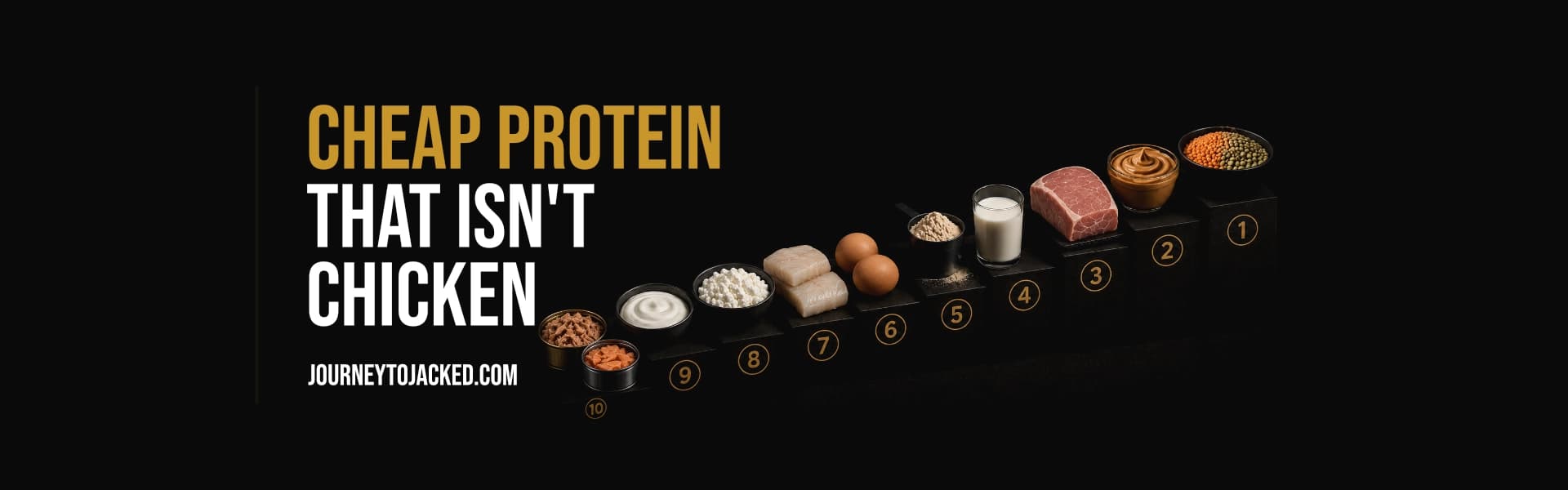
Cheap Protein That Isn't Chicken, Ranked
Ranked by cost per gram of protein instead of cost per pound, so you know which budget foods actually beat chicken and what a week of them costs.
Chicken breast is not the cheapest protein in your grocery store. It is not even in the top five.
The reason nobody notices is that almost every budget protein list ranks foods by price per pound. Price per pound tells you nothing. Chicken breast is roughly 70 percent water, and what you are actually buying is grams of protein.
So that is the unit here. Every food below is ranked by cost per 30 grams of protein, which is one solid protein serving. Prices are US averages from mid-2026 and swing 10 to 20 percent by region and store. The ranking holds. The exact numbers will not, so check your own shelf.
What is the cheapest protein per gram that isn't chicken?
Dried lentils and dried beans win outright at roughly 50 to 60 cents per 30 grams of protein. Milk, pork loin, and bulk whey concentrate all land under a dollar. Eggs, cottage cheese, canned tuna, and tofu sit between $1.25 and $2.00. Chicken breast is nowhere near the top.
That is the short answer. The rest of this covers what those numbers hide, because cheapest per gram and best for your body are not always the same food.
Why does every budget protein list rank foods differently?
Because most of them compare foods in different states. Dry weight, cooked weight, and bone-in weight produce wildly different numbers from the same food, which is how one list crowns lentils and the next crowns milk.
Three rules fix it:
- Price the dry weight, eat the cooked weight. A pound of dry lentils holds about 100 grams of protein and roughly triples in weight once cooked. Comparing cooked lentils to dry lentils is how you get those "180 grams per dollar" claims.
- Count edible yield only. Bone-in cuts run around 70 percent usable weight. Pay for the bone if you want. Do not count it.
- Read the label, not the list. Protein per 100 grams varies by brand, especially for tofu, yogurt, and cottage cheese.
Apply those three and the ranking below stops moving.
10 cheap protein sources that beat chicken on price
Each entry shows cost per 30 grams of protein and calories per 30 grams of protein. That second number matters more than most people expect.
1. Dried lentils and split peas
About $0.50 per 30g protein. About 420 calories.
The outright price winner, and nothing is close. A one pound bag runs under two dollars and holds roughly 100 grams of protein. They cook in 20 minutes with no soak. The cost is time and carbs, not money.
2. Peanut butter
About $0.65 per 30g protein. About 810 calories.
Cheap on paper, brutal in practice. Getting 30 grams of protein from peanut butter means eating close to half a jar. Use it as a calorie tool when you are gaining. Never as a protein anchor when you are cutting.
3. Pork loin
About $0.90 per 30g protein. About 170 calories.
The most underrated protein in the store. Lean loin runs $2.50 to $3.50 per pound at roughly 22 grams of protein per 100 grams raw, which puts it near chicken breast for density at a fraction of the price. Buy the whole loin and cut your own chops.
4. Milk
About $0.90 per 30g protein on 1%. About 375 calories.
A gallon holds roughly 128 grams of protein for under four dollars. Zero cooking, blends with anything, and it doubles as a training-day calorie source. Use 1% rather than whole if calories are tight.
5. Bulk whey concentrate
About $0.95 per 30g protein. About 155 calories.
Buy the 5 lb tub, not the 2 lb one. Concentrate, not isolate. Bought that way, whey is one of the cheapest and leanest protein sources you can own. Bought as ready-to-drink shakes or bars, it becomes one of the most expensive.
6. Eggs
About $1.25 to $1.90 per 30g protein. About 360 calories.
Five eggs, 30 grams, done. Egg prices have swung hard since the bird flu outbreaks, so eggs move up and down this list more than anything else on it. Price them the week you shop.
7. Frozen white fish
About $1.65 per 30g protein. About 130 calories.
Pollock, tilapia, and cod in bulk frozen bags. The best calorie-to-cost ratio here by a wide margin. Nearly pure protein, cooks from frozen in 15 minutes, keeps for months.
8. Cottage cheese
About $1.60 per 30g protein. About 220 calories.
Low fat cottage cheese runs about 11 grams of protein per 100 grams. No cooking, high satiety, works savory or sweet. The 24 oz tub always beats the snack cups per gram.
9. Greek yogurt
About $1.80 per 30g protein. About 180 calories.
Buy the large plain tub and add your own fruit. Flavored single-serve cups cost roughly double per gram and bring sugar you did not ask for.
10. Canned tuna and canned salmon
About $1.75 to $2.00 per 30g protein. About 190 calories.
Shelf stable, lean, and no cooking at all. Cap tuna at two or three servings a week for mercury, and rotate canned salmon or sardines in for the omega-3s.
Ground beef 80/20 sits just outside this list at roughly $2.00 per 30 grams and 430 calories. It is fine. It is just not the value play most people assume it is.
Do beans and lentils build muscle as well as meat does?
Close enough to matter, provided you eat enough. A 2021 meta-analysis of 16 randomized controlled trials found protein source did not change absolute lean mass or strength gains, with a small effect favoring animal protein on percent lean mass 1. Total daily protein drives the result far more than the source does.
The practical catch is volume. Plant sources carry less leucine per gram and arrive packaged with carbs and fiber, so hitting a target on lentils alone means eating a lot of food.
That is why the smart budget build is mixed:
- Anchor at least two meals a day with an animal or dairy source if you eat them
- Pair beans and lentils with grains or dairy in the same meal for a fuller amino acid profile
- Keep the cheapest plant sources as your base, not your whole plan
Your target still comes first. Research puts the plateau for training-induced muscle gain near 1.6 grams of protein per kilogram of bodyweight per day 2. Work out how much protein you actually need before you optimize the price of it.
Are cheap protein foods too high in calories for fat loss?
Some are, badly. Peanut butter costs 810 calories per 30 grams of protein. Frozen white fish costs 130. Same protein, six times the calories, and only one of them survives a deficit.
Split the list by what you are doing.
Cutting picks, under 250 calories per 30g protein:
- Frozen white fish
- Bulk whey concentrate
- Pork loin
- Canned tuna
- Cottage cheese
- Greek yogurt
Bulking picks, where the calories are a feature:
- Peanut butter
- Whole milk
- Dried beans and lentils
- Ground beef 80/20
- Eggs
Nothing on the second list is bad food. It just costs you calorie room you may not have.
Is protein powder cheaper than real food protein?
Bought right, yes. A 5 lb tub of whey concentrate lands near 95 cents per 30 grams of protein, which beats eggs, tofu, yogurt, and every cut of meat except pork loin. Bought as ready-to-drink shakes or protein bars, it costs three to five times more per gram.
Price is not the whole argument. Powder is less filling than food, and satiety is most of what makes a cut survivable. Treat it as a gap-filler for days your schedule wins, not a replacement for meals. More on that in protein powder: do you actually need it.
What does a week of budget protein look like on the grocery list?
Roughly $40 to $50 for one person eating about 150 grams a day. Here is the cart:
| Item | Cost | Protein |
|---|---|---|
| 2 lb dried lentils | $3.50 | 200g |
| 1 gallon 1% milk | $3.80 | 128g |
| 2 dozen eggs | $7.00 | 144g |
| 2 lb pork loin | $6.00 | 200g |
| 2 lb frozen pollock | $9.00 | 180g |
| 24 oz cottage cheese | $4.00 | 75g |
| 4 cans tuna | $5.00 | 100g |
| 32 oz Greek yogurt | $5.50 | 90g |
| Total | ~$44 | ~1,117g |
That is about 160 grams a day with room to spare, and not one chicken breast in it. Add rice, oats, frozen vegetables, and cooking oil on top and the full week still lands well under a hundred dollars.
The cart works because it repeats. Five or six proteins on rotation beats twenty you buy once and forget in the freezer. If your bottleneck is cooking time rather than money, the three anchor meal approach does the same job without a Sunday prep session.
What to Do Next
Price your own store this week. Take the three cheapest items above that you will actually eat, buy them, and build every meal around one of them.
The number you are aiming at is personal though. Bodyweight, training load, and whether you are cutting or gaining all move it. Buying cheap protein for the wrong target just makes you efficiently wrong.
Your Next Step
Stop guessing. Start building.
Get a personalised training plan built around your body, your goals, and your schedule — ready in minutes, yours forever.
Get Your PlanReferences
Footnotes
-
Lim, M. T., Pan, B. J., Toh, D. W. K., Sutanto, C. N., & Kim, J. E. (2021). Animal protein versus plant protein in supporting lean mass and muscle strength: a systematic review and meta-analysis of randomized controlled trials. Nutrients, 13(2), 661. https://doi.org/10.3390/nu13020661 ↩
-
Morton, R. W., Murphy, K. T., McKellar, S. R., et al. (2018). A systematic review, meta-analysis and meta-regression of the effect of protein supplementation on resistance training-induced gains in muscle mass and strength in healthy adults. British Journal of Sports Medicine, 52(6), 376-384. https://doi.org/10.1136/bjsports-2017-097608 ↩