
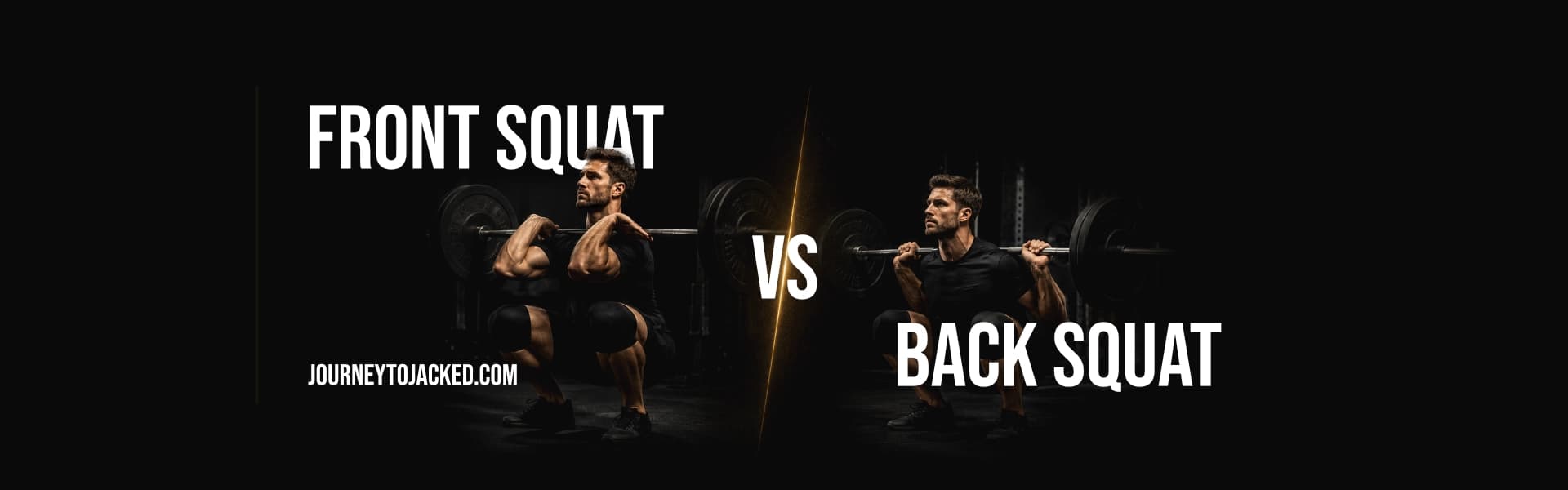
Front Squat vs Back Squat: Pick One and Move On
Front squat vs back squat: mobility, goals, and comfort decide it, not muscle charts. Here is how to pick one in five minutes and get back to training.
You have one squat in your week and two options. Every article you find says do both, which is not an answer when you have 60 minutes and a barbell.
So here is the answer. The front squat vs back squat decision comes down to three things: whether you can hold the bar, what you are training for, and which one your joints tolerate. Muscle charts do not decide it. You do.
The short version
| Front squat | Back squat | |
|---|---|---|
| Bar position | Front of shoulders | Upper back |
| Load you can use | Roughly 80 to 90% of your back squat | Your heaviest squat |
| Bias | Quads, upper back, trunk | Quads, glutes, hamstrings |
| Entry barrier | Front rack mobility | Bracing under heavy load |
| Fails safely | Yes, the bar rolls forward | Only with a rack or a spotter |
| Best for | Quad bias, upright torso | Max load, posterior chain, powerlifting |
Find the row that matters most to you. That is your squat.
Front squat vs back squat: which builds more muscle?
Neither. A 12-week trial had trained women squat twice a week, one group front, one group back. Quad thickness grew in both by roughly 4 to 5 percent with no meaningful difference between them. The back squat group did gain more on a leg press strength test 1.
That trial used 24 women and one strength test, so do not treat it as settled. It points the same direction as the lab work, though. In a biomechanics study, overall muscle recruitment was similar between the two lifts even though people front squatted less weight 2.
EMG measures activation in a single session, not growth over months, so it supports the training data rather than proving anything on its own.
The practical version is simple. You will front squat a smaller number and your quads will not care.
If your ego needs the bigger number, that is worth knowing about yourself before you pick.
Are front squats really easier on your lower back?
Partly, and not for the reason people repeat. The bar sits closer to your spine and your torso stays upright, which cuts the demand at your hips. But your trunk muscles work harder, not less. In one lab session with 26 young men, abdominal and lower back muscle activity was higher in the front squat, and that was with the front squat loaded at only 75 percent of their back squat working weight 3.
So the front squat is not a rest for your midsection. It is a harder job for it with a lighter bar.
That distinction matters. If your lower back complains because you fold forward under a heavy bar, an upright torso will help. If it complains from bracing and fatigue at the end of a hard set, the front squat may feel exactly the same.
If your lower back takes over on everything you do, that is usually a bracing and hinge problem.
Why do your wrists hurt in the front rack position?
Your wrists are rarely the problem. Tight lats, tight triceps, and a stiff upper back stop your elbows from coming up. The bar slides toward your fingers, and your wrists end up holding weight they were never built to hold. Raise the elbows and most of the pain goes with them.
Run through these before you give up on the lift:
- Widen your grip until your wrists sit under the bar without strain
- Let your fingers come off the bar. Two or three fingers is plenty
- Rest the bar on the shelf of your front delts, not in your palms
- Drive your elbows up until your upper arms sit near parallel to the floor
- Use straps or a cross-arm grip if your shoulders will not cooperate yet
The 30-second front rack test
Load an empty bar. Rack it across your delts, elbows up, and hold for 30 seconds. No pain and the elbows stay high? You can front squat today. Elbows sink or wrists burn? Back squat for now and work the mobility on the side.
A lift you dread is a lift you skip. Do not force it.
Which squat is easier on cranky knees, front or back?
Often the back squat, which is the opposite of what most articles claim. Keeping your torso upright in a front squat drives your knees further forward and demands more knee bend, and more knee bend means more work for the joint.
The research usually gets cited the other way. That same biomechanics study found lower knee compressive force and lower knee extensor moments in the front squat 2. But the lifters used lighter loads when they front squatted, so the gap may come from the weight rather than the bar position.
Depth changes the picture too, since how deep you squat drives how much knee flexion you pile up.
Practical answer: stop reasoning about your knees and test them. Run each variation for two weeks at the same effort. Keep the one that leaves your knees quiet the next morning. Your knees are better evidence for your body than any group average.
How much should you front squat compared to your back squat?
Coaches commonly use 80 to 90 percent as the rough target. If you have barely front squatted, expect 60 to 70 percent at first, and expect it to climb fast. That early gap is a skill and position problem, not a leg strength problem.
Use the ratio as a diagnostic:
- Under 70 percent while training both: your rack position or upper back is the limiter
- 80 to 90 percent: normal, nothing to fix
- Above 90 percent: your back squat is undertrained, not your front squat overtrained
The spread between real lifters is wide, so do not chase a number. It tells you where to work, not what to lift.
Can you skip back squats and only front squat?
Yes, unless you compete in powerlifting. Nothing in the back squat is irreplaceable for general strength and muscle.
One adjustment if you drop it. The front squat asks less of your glutes and hamstrings, so add a hinge. Romanian deadlifts, hip thrusts, or conventional pulls cover what you gave up.
It works in reverse too. Hate the front rack and never want to touch it? Back squat, add some quad-biased work, and get on with your training.
Pick one and run it for eight weeks
The lift you do consistently beats the lift that scores better on paper. Choose with three filters:
- Can you hold the bar without pain? If not, that variation is out today
- What are you training for? Max load and posterior chain means back squat. Quad bias and an upright torso means front squat
- Which one leaves your joints quiet? Two weeks each. Your body decides
Then run it for eight weeks and add weight or reps every session you can. That is where the results come from. Not from the bar position.
Your Next Step
Stop guessing. Start building.
Get a personalised training plan built around your body, your goals, and your schedule — ready in minutes, yours forever.
Get Your PlanReferences
Footnotes
-
Enes, A., Oneda, G., Leonel, D. F., Lemos, L., Alves, F., Ferreira, L. H. B., Escalante, G., Schoenfeld, B. J., & Souza-Junior, T. P. (2024). The effects of squat variations on strength and quadriceps hypertrophy adaptations in recreationally trained females. European Journal of Sport Science, 24(1), 6-15. https://doi.org/10.1002/ejsc.12042 ↩
-
Gullett, J. C., Tillman, M. D., Gutierrez, G. M., & Chow, J. W. (2009). A biomechanical comparison of back and front squats in healthy trained individuals. Journal of Strength and Conditioning Research, 23(1), 284-292. https://doi.org/10.1519/JSC.0b013e31818546bb ↩ ↩2
-
McCormick, J. B., Drusch, A. S., Lynch, D. J., Seeber, G. H., Wilford, K. F., Hooper, T. L., Allen, B. S., O'Connell, D. G., Mena-Iturriaga, M. J., Cooper, K. J., & Sizer, P. S. (2023). The effect of volitional preemptive abdominal contraction on biomechanical measures during a front versus back loaded barbell squat. International Journal of Sports Physical Therapy, 18(4), 831-844. https://doi.org/10.26603/001c.84306 ↩