
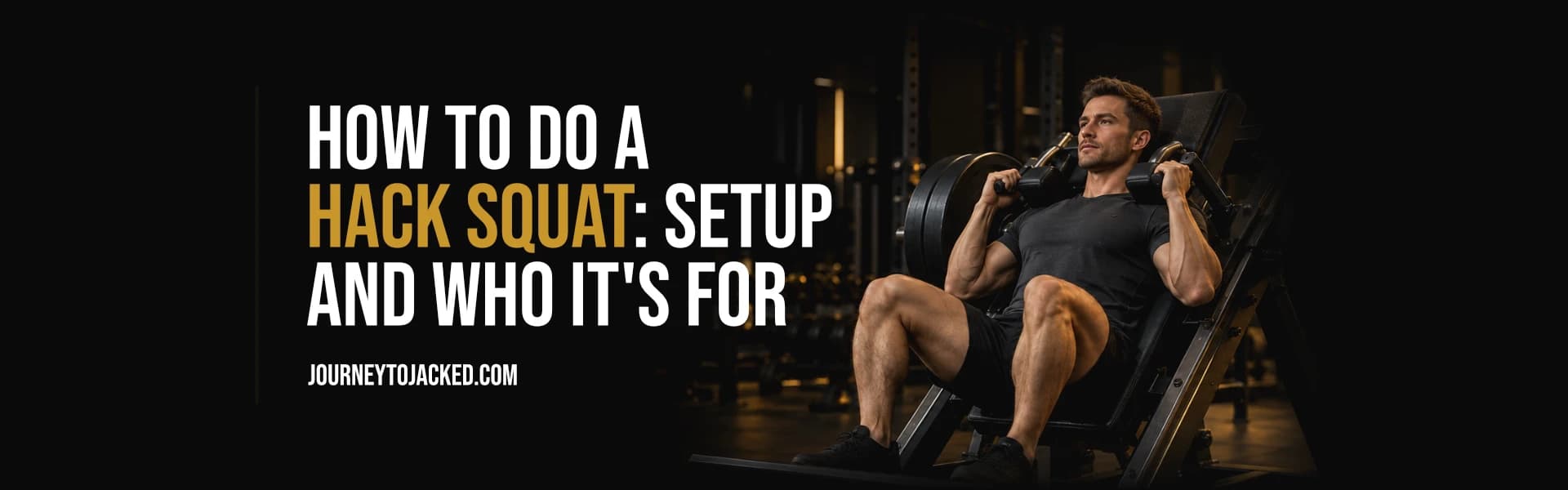
How to Do a Hack Squat: Setup and Who It's For
Set up the hack squat right: where your feet go for quads, what the empty sled weighs, and who should pick it over squats or the leg press.
The hack squat sits in most commercial gyms and gets walked past on leg day. Set it up right and it puts heavy, direct work into your quads while a pad holds your back in place.
Most lifters who try it get the setup wrong. Feet too high. Plates loaded without counting the sled. Hips peeling off the pad at the bottom. Here is how to do a hack squat, where your feet go, and who should pick it over squats or the leg press.
How do you set up a hack squat machine?
Step onto the platform with your back flat on the pad and your shoulders under the shoulder pads. Set your feet shoulder-width, mid-platform, toes turned out slightly. Release the safety handles, lower under control until your hips start to leave the pad, then drive up through your whole foot.
Run the same checklist every set:
- Adjust the shoulder pads. If the machine has a height setting, set it so the pads sit on your shoulders without you crouching to get under them.
- Get your whole back on the pad. Upper back, lower back, and hips all touch it. They stay there for the entire set.
- Set your feet. Shoulder-width, middle of the platform, toes out 10–20 degrees. Adjust from there using the next section.
- Brace and release. Breathe into your belly, brace, press up slightly, and flip the safety handles out.
- Lower for 2–3 seconds. Let your knees travel forward over your toes. That knee travel is what makes this a quad exercise.
- Stop at your depth. Go as low as you can while your heels stay flat and your hips stay on the pad. The research on how low you need to squat applies here too.
- Drive up and stop just short of lockout. Push through the whole foot. A slight bend at the top keeps tension on the quads.
- Lock the safety handles. Flip them back in before you step off. Every set.
Where should your feet go on a hack squat for quads?
Start mid-platform at shoulder width. Move your feet lower an inch at a time until your heels start to lift at the bottom, then come back up one step. That is your quad stance: as low as your feet go while staying flat.
Lower feet let your knees travel farther forward, which means more knee bend and more work for the quads. Higher feet put more of the bend at the hips, so your glutes and hamstrings pick up more of the load.
Barbell squat research shows what happens when the knees are held back. When lifters were stopped from letting their knees pass their toes, torque at the knee dropped, torque at the hip jumped, and they leaned their torso further forward1. On a hack squat the pad fixes your torso in place, so letting your knees travel is how the quads get the work.
| Foot position | Shifts the work toward | Use it when |
|---|---|---|
| Low on the platform | Quads | Quad growth is the goal and your heels stay flat |
| Middle, shoulder-width | Quads, some glutes | Your default starting stance |
| High on the platform | Glutes and hamstrings | Your knees are cranky or you want more hip work |
| Wide stance | Adductors (inner thigh) | Your hips are mobile enough to sit between your knees |
If your heels lift, your feet are too low for your ankles. Move them up. Do not fight it by rising onto your toes.
How much does an empty hack squat sled weigh?
Most hack squat sleds weigh somewhere between about 50 and 125 lb before you add a single plate, and some run heavier. The exact number changes by brand and model, so check the sticker on the frame or the manufacturer's spec sheet. That sled is part of every rep you do.
The sled rides on an angled track, so the resistance you feel is less than its listed weight. How much less depends on the angle, which changes from machine to machine.
Three rules follow from that:
- Start lighter than you think. Plenty of lifters throw a 45 on each side, forget the sled, and grind out five ugly reps on their first try.
- Log it the same way every time. Write plates only, or plates plus sled. Pick one and never switch. What matters is that the number climbs, so track every session.
- Never compare hack squat numbers across machines. Different sled weights and track angles make two gyms' numbers meaningless side by side. Compare yourself to last week on the same machine.
Why do your knees hurt on the hack squat?
Usually it is the setup. The common faults are heels lifting off the platform, feet set lower than your ankles can handle, knees caving in, and hips peeling off the pad at the bottom. Most of these get fixed in a single session.
Work through them in this order:
- Heels lifting: move your feet up an inch at a time until your whole foot stays flat at the bottom.
- Hips leaving the pad: you went past your usable depth. Stop an inch higher or drop the weight.
- Knees caving in: push your knees out in line with your toes. If they still cave, the load is too heavy.
- Bouncing out of the bottom: slow the last few inches and pause for a beat before you drive up.
If the knee still aches with a clean setup, shorten the range. Squat and leg press research found knee forces were lowest in the upper range of knee bend, roughly 0–50 degrees, and suggested training there when the goal is to keep those forces down2.
Train at the depth that stays pain-free, then add range back as the knee settles. Sharp pain, swelling, or pain that gets worse week to week means stop and get it looked at by a physio.
If an old knee injury is part of the picture, these squat swaps keep your leg training moving.
Should you hack squat or leg press for bigger quads?
Both build quads. Pick the hack squat if your gym has one and you want a squat pattern with your back supported. Pick the leg press if the hack squat bothers your knees or back, or you want to train one leg at a time. The better machine is the one you can load hard, pain-free, for months.
We could not find a study that compares the two head to head for quad growth, so choose by fit:
| Hack squat | Leg press | |
|---|---|---|
| Body position | Standing, load on your shoulders | Seated and reclined, load at your feet |
| Top of the rep | Hips fully extended | Hips stay bent |
| Availability | Less common | In nearly every gym |
| Single-leg sets | Awkward to set up | Easy |
| Load you can handle | Usually less | Usually more |
Do not compare your numbers between the two. A leg press number will usually run higher, and that says nothing about which one is working your quads harder.
Plenty of lifters run both: hack squat first while fresh, leg press after for extra volume.
Who should hack squat instead of back squat?
Use the hack squat if quad size is your goal, your lower back caps how hard you can squat, or you want more leg volume after heavy barbell work. Stick with the back squat if you want a bigger barbell squat, you compete, or you want the trunk training that comes with balancing a bar.
That trunk point is real. In a study of 10 trained men, the back squat produced higher trunk muscle activation than the hack squat at the same relative loads in every trunk muscle measured, with one exception: the front abdominal muscle on the way up3. The pad does the stabilizing job your trunk would otherwise do.
The hack squat fits best for:
- Lifters chasing quad size. The torso is fixed, the stance is quad-biased, and the safety handles let you push close to failure without a spotter.
- Lifters whose lower back limits their squat. The pad takes over the balancing job, so your legs can work harder before your back gives out.
- Lifters adding leg volume. Hack squats after heavy squats add quad work without another heavy barbell on your back.
The back squat stays the pick if a barbell squat number is the goal. Machine strength only partly carries over to the barbell, and the machines vs free weights breakdown covers why, along with which one a beginner should start on. Want the barbell but more upright? The front squat is the free-weight middle ground.
What should you do on your next hack squat session?
Set your feet mid-platform, walk them down until your heels lift, then come back one step. Find the depth where your hips stay on the pad. Write down the sled weight and how you log it.
Then run that stance for the next eight weeks and add reps or weight every session you can.
Your Next Step
Stop guessing. Start building.
Get a personalised training plan built around your body, your goals, and your schedule — ready in minutes, yours forever.
Get Your PlanReferences
Footnotes
-
Fry, A. C., Smith, J. C., & Schilling, B. K. (2003). Effect of knee position on hip and knee torques during the barbell squat. Journal of Strength and Conditioning Research, 17(4), 629-633. https://doi.org/10.1519/00124278-200311000-00001 ↩
-
Escamilla, R. F., Fleisig, G. S., Zheng, N., Lander, J. E., Barrentine, S. W., Andrews, J. R., Bergemann, B. W., & Moorman, C. T. (2001). Effects of technique variations on knee biomechanics during the squat and leg press. Medicine and Science in Sports and Exercise, 33(9), 1552-1566. https://doi.org/10.1097/00005768-200109000-00020 ↩
-
Clark, D. R., Lambert, M. I., & Hunter, A. M. (2019). Trunk muscle activation in the back and hack squat at the same relative loads. Journal of Strength and Conditioning Research, 33(Suppl 1), S60-S69. https://doi.org/10.1519/JSC.0000000000002144 ↩